
Berkey vs LifeStraw Mission 2026: Which Water Filter to Buy
The Big Berkey wins for daily home water; the LifeStraw Mission wins for emergencies. Berkey vs LifeStraw Mission comes down to chemicals versus pathogens.

Practical home resilience for normal families. No bunkers, no ideology. Just sensible preparation that saves money and stress when things go sideways.
Just so you know, some links on this page are affiliate links. If you buy something via them, we get a small kickback. You don't pay more, but it helps keep this independent.
Not sure what to buy? Take the quiz.
Find My SetupIf you are choosing between the Big Berkey and the LifeStraw Mission, the honest answer is that they are built for two different jobs, and the right one depends on which job you are actually buying for. For everyday drinking water at home, get the Big Berkey: it is a permanent countertop system whose elements target the dissolved contaminants a membrane physically cannot touch, things like lead, chlorine byproducts and other chemicals. For emergencies, camping and untreated water from a stream or a rain barrel, get the LifeStraw Mission: it is a collapsible gravity purifier that kills viruses, bacteria and parasites, packs into a bag, and needs no power.
So the real question is not which one is better. It is which threat you are solving. Stay with me, because getting that backwards is how people end up with the wrong filter for the water they actually have.
Quick Picks
One note on how I have handled the claims below. Water filtration is a field full of marketing numbers, so I have stuck to what each maker can actually evidence: independent standards where they exist, the manufacturers' own published lab data where they do not, and the public record of the EPA matter affecting Berkey. Where a claim is the company's own testing rather than an independent certification, I say so.
The Two Jobs These Actually Do
Most head-to-head guides treat these as rivals fighting over the same buyer. They are not. Understanding the split is the whole point, because it tells you which one belongs on your counter and which one belongs in your bag.
The Big Berkey is a home water system. It sits on the kitchen counter, you pour tap water in the top, and it improves the water you drink every day. Its job is breadth: reducing the range of things that can be dissolved in treated municipal water, from chlorine and its byproducts to heavy metals like lead. That is a chemistry problem as much as a pathogen problem, and it is the problem most people on town water actually have.
By contrast, the LifeStraw Mission is an emergency and expedition purifier. It is a roll-up bag you hang from a branch or a hook, fill from whatever water you can find, and let gravity pull through a membrane. Its job is depth against living threats: making biologically unsafe water safe to drink when the source is a stream, a lake, a rain barrel, or a tap you do not trust after a disaster. It does that job about as well as any portable product on the market, and it does not care whether there is power or plumbing anywhere nearby.
So which of those two situations is actually yours? If it is the first, the Berkey is your tool. If it is the second, the Mission is. And if the answer is honestly both, which is common in a resilient household, you may end up owning one of each for very different reasons.
Big Berkey: The Everyday Home System
The Big Berkey is a 2.25-gallon stainless steel gravity system, and for a household that wants better daily drinking water, it is the more complete tool. Two chambers, no plumbing, no power: you pour water in the top, it filters down through a pair of Black Berkey elements, and you draw it from a spigot.

Its real strength is the range of what its elements are built to reduce. Berkey's own published testing describes its Black Berkey elements cutting a broad list of contaminants, including chlorine and chlorine byproducts, heavy metals such as lead, and a wide set of chemicals, with optional add-on filters for fluoride and arsenic. That breadth is the thing a membrane purifier like the Mission simply does not attempt. If the water you are treating is treated town supply, and your worry is what is dissolved in it rather than what is living in it, the Berkey is aimed squarely at your problem.
The other strength is capacity and independence. It holds and filters far more at a time than a pitcher, its elements are rated for a long service life per pair, and because it runs on gravity it keeps working in a grid-down situation. That combination is why it has such a devoted following among preparedness-minded households.
Now the honest limitations, and there are two that matter. First, Berkey is not NSF certified. The company publishes results from third-party laboratories to support its claims, which is real testing, but it is the maker commissioning and publishing the tests rather than an independent certifier putting its seal on the finished product. For most buyers that is a footnote; for anyone filtering water for children or vulnerable family members, an independently certified option is the more conservative call. Second, and more pressing, is the current question mark over its replacement elements, which I will come to below. Buy the Berkey for its genuine breadth, but go in knowing both of these.
Check the Big Berkey price on Amazon
LifeStraw Mission: The Emergency and Off-Grid Purifier
The LifeStraw Mission is a different class of tool, and for the emergency job it is the one I would reach for. It is a rugged collapsible bag, offered in 5-liter and 12-liter sizes, with a quick-connect hose and a purification cartridge. You fill the bag, hang it up, and gravity does the work through the membrane. No pumping, no power, no plumbing.
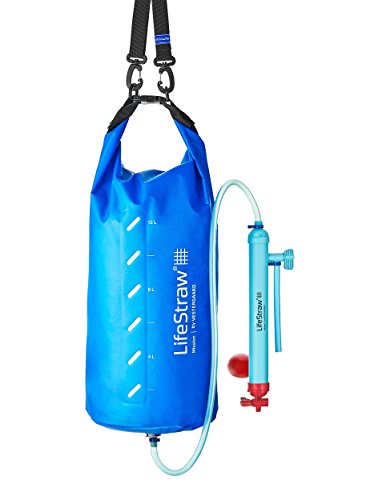
What sets it apart is that it is a genuine purifier, not just a filter. Its membrane uses 0.02-micron ultrafiltration, fine enough to remove viruses as well as bacteria and parasites. LifeStraw states it removes 99.999% of viruses such as rotavirus and hepatitis A, 99.999999% of bacteria such as E. coli and salmonella, and 99.999% of parasites such as giardia and cryptosporidium, along with microplastics and the silt and cloudiness that come with wild water. It meets the NSF/ANSI P231 standard for microbiological water purifiers and has been independently tested to WHO and US EPA protocols. That virus removal is the line that separates it from most portable filters, including the basic LifeStraw and the Sawyer Squeeze, which handle bacteria and parasites but not viruses.
It is also built to keep going. A built-in backwash system restores the flow rate as the membrane loads up, and each cartridge is rated for up to 18,000 liters, which is years of water for a family or a group. It flows at up to 12 liters an hour on gravity alone. Fold it up and it disappears into a bug-out bag or a car kit.
The honest limitation is the flip side of how it works. A membrane removes things by size, so it is superb against anything living or particulate, but it does nothing about what is dissolved. There is no activated carbon in the Mission, which means it does not remove chemicals, heavy metals like lead, PFAS, or fluoride, and it does not improve taste or odor. That is not a defect; it is the design. The Mission is meant to make questionable water microbiologically safe in the field, not to polish your home tap water. Use it for the job it is built for and it is excellent. Expect it to strip lead out of your kitchen supply and you have bought the wrong tool.
Check the LifeStraw Mission price on Amazon
What a Membrane Can and Cannot Do
This is the technical heart of the comparison, and it is worth ten minutes of your attention because it decides the whole thing. Portable purifiers like the Mission clean water mechanically. The membrane is a wall of hollow fibers with pores measured in fractions of a micron, and anything bigger than the pore, which includes viruses, bacteria, protozoa, sediment and microplastics, physically cannot pass. It is brutally effective against living threats and needs no chemistry to do it.
What a bare membrane cannot do is capture anything dissolved, because dissolved molecules are far smaller than any pore that still lets water flow. Lead ions, chlorine, PFAS "forever chemicals", pesticides, the compounds that make water taste of the pipe it came through: a membrane lets all of those straight through. To catch dissolved contaminants you need a different mechanism, usually activated carbon or ion exchange, which is exactly what home systems build in and what the Mission deliberately leaves out to stay light and fast.
The Berkey approaches it from the other end. Its Black Berkey elements combine media designed to reduce that dissolved load, chemicals and metals included, along with pathogen reduction, which is why the maker positions it as an all-round drinking-water system rather than a field purifier. The trade is that it is a heavy countertop unit you are not carrying anywhere, and its evidence is self-published rather than NSF-certified.
So the mechanisms map cleanly onto the two jobs. If your threat is biological, from an untreated or unreliable source, the membrane wins and the Mission is the purest expression of it. If your threat is chemical, from a treated supply you drink every day, the media-based home system wins and the Berkey is the broader tool. Neither mechanism is a substitute for the other, and that is the honest bottom line.
The Berkey Element Question
If you searched for Berkey and landed here, you need the current picture before you spend anything, because it directly affects whether the system is a smart long-term buy.
Berkey systems are still being sold, and complete systems generally ship with their Black Berkey elements included. The complication is the elements themselves. The EPA classified the Black Berkey elements as an unregistered pesticide device under federal law (FIFRA), because of the antimicrobial silver they contain, and issued a stop-sale that halted production of the standalone replacement elements. The manufacturer, New Millennium Concepts Ltd, has challenged that classification through more than one legal proceeding, and as of 2026 the dispute is still unresolved. The company itself has said it expects some form of resolution during 2026, though that is its own stated expectation rather than a fixed court date.
The practical upshot for a buyer is about supply, not safety: standalone Black Berkey replacement elements have been sold out at authorized dealers while the stop-sale stands, with Phoenix elements, tested to NSF/ANSI 42 and 372, offered as the stand-in. To be clear about what this is and is not, this is a regulatory and supply dispute over the elements, and Berkey is not bankrupt or out of business. But buying a filtration system whose long-term replacement-element supply depends on the outcome of a federal appeal is a real consideration, and it is worth weighing against a purifier like the Mission, whose cartridges are not tangled in any dispute.
Head-to-Head
| What matters | Big Berkey | LifeStraw Mission | Winner |
|---|---|---|---|
| Primary job | Everyday home drinking water | Emergency and untreated-source purifying | Depends on need |
| Dissolved contaminants (lead, chemicals, chlorine) | Reduced per maker's own testing | Not removed (no carbon stage) | Big Berkey |
| Viruses | Claimed by maker's testing | Removed to NSF/ANSI P231 standard | LifeStraw Mission |
| Bacteria and parasites | Yes | Yes, independently tested | Draw |
| Independent standard | Not NSF certified | Meets NSF/ANSI P231; WHO/EPA tested | LifeStraw Mission |
| Portability | Heavy countertop fixture | Collapsible bag for a go-kit | LifeStraw Mission |
| Off-grid and no-power use | Yes, gravity-fed | Yes, gravity-fed | Draw |
| Replacement-supply certainty | Tied to the ongoing EPA case | Cartridges unaffected | LifeStraw Mission |
| Taste and odor improvement | Yes | No | Big Berkey |
Read that table by column, not by row count. The Mission wins more lines, but most of them are about the emergency job. The two lines the Berkey wins, dissolved contaminants and taste, are the entire reason a home system exists. This is a split about purpose, not a scoreboard.
Which One Should You Buy
Buy the **Big Berkey** if you are treating municipal tap water for a household and your concern is what is dissolved in it, especially lead, chlorine and general chemistry, or if you want a single high-capacity system that also keeps producing drinking water in a grid-down week. Go in clear-eyed about two things: it is not NSF certified, and its replacement elements are under the EPA cloud described above. For daily home water where breadth matters more than portability, it is still the more complete tool.
Buy the LifeStraw Mission if the water you most need to make safe is untreated or unreliable: stream and lake water on a trip, rain-barrel or floodwater after a disaster, or a foreign tap you do not trust. Its virus-grade membrane, its packability, and its independent P231 backing make it the purifier I would want in an emergency kit. Just do not ask it to remove lead or chemicals from your kitchen supply, because that is not what a membrane does.
And if you are building genuine home resilience, the honest answer is often one of each: the home system for the water you drink every day, and the packable purifier for the day the tap stops being trustworthy. They are not really competitors. They are two halves of a water plan. If you want the wider field of countertop options, my best gravity water filter guide covers the systems that never got caught up in the Berkey element dispute, and if you are stocking a go-bag, lifestraw vs sawyer squeeze settles the lighter personal-filter choice.
What to Avoid
Avoid buying the LifeStraw Mission expecting it to clean up your home tap water. It is a superb pathogen purifier and a poor chemical filter, by design. If lead or chlorine is your worry, a membrane will not touch it, and you want a media-based home system instead.
Avoid buying a Berkey on the strength of the brand name alone without understanding the replacement-element position. The hardware is good, but a filter system is only as useful as your ability to keep buying elements for it, and that is the open question right now. Weigh it before you commit, not at your first replacement.
And avoid the trap of thinking one product covers every water threat. No single portable filter or home system does both jobs perfectly. A membrane misses chemicals; a home system is not going in your backpack. Matching the tool to the actual threat, and to where you will use it, is the whole skill here. When the source water may carry pathogens from the wild, filtration is only part of the answer, and my water purification methods guide explains where boiling and chemical treatment come in.
What I'd Buy Today
If I could only buy one and I was mostly filtering town tap water for a household, I would buy the Big Berkey. It handles the dissolved contaminants that matter in everyday drinking water, it keeps running off-grid, and for daily use its breadth beats a membrane, as long as you accept the element caveat.
Get the Big Berkey on Amazon for the counter. Then, if you are serious about being ready for the day the water source is a stream or a storm, add the LifeStraw Mission to the emergency kit, because that is the moment a virus-grade purifier earns its place. Either way, the goal is the same: water you can pour without thinking twice, whether it comes from your tap or from a barrel behind the shed.
As an Amazon Associate, we earn from qualifying purchases.
Products Mentioned in This Guide
Big Berkey Gravity-Fed Water Filter System (2.25 Gallon)
Berkey
2.25-gallon stainless steel gravity-fed countertop system supplied with two Black Berkey elements. N...
LifeStraw Mission High-Volume Gravity-Fed Water Purifier (12L)
LifeStraw
12-liter collapsible gravity-fed purifier using 0.02-micron membrane ultrafiltration. Removes viruse...
Not sure what to buy?
Tell me about your home and I'll tell you which resilience gap to close first.
Find My SetupFrequently Asked Questions
Is the Big Berkey or LifeStraw Mission better?
They do different jobs. The Big Berkey is the better everyday home system because its elements reduce dissolved contaminants like lead, chlorine and chemicals that a membrane cannot touch. The LifeStraw Mission is the better emergency purifier for untreated water, because its 0.02-micron membrane removes viruses, bacteria and parasites and it packs into a bag.
Does the LifeStraw Mission remove viruses?
Yes. Its 0.02-micron membrane ultrafiltration removes 99.999% of viruses along with bacteria and parasites, and it meets the NSF/ANSI P231 purifier standard. That virus removal is what separates it from most portable filters, including the basic LifeStraw and the Sawyer Squeeze, which stop at bacteria and parasites.
Does the LifeStraw Mission remove chemicals or lead?
No. It is a membrane-only purifier, so it removes anything living or particulate but nothing dissolved. It does not remove chemicals, heavy metals like lead, PFAS or fluoride, and it does not improve taste, because there is no activated carbon in it. For dissolved contaminants you need a media-based home system like the Berkey.
Is Berkey going out of business?
No. Berkey is not bankrupt and systems are still sold. The EPA classified the standalone Black Berkey elements as an unregistered pesticide device under FIFRA and issued a stop-sale on the replacement elements, which the maker is challenging in ongoing litigation that remains unresolved as of 2026. The issue is replacement-element supply, not safety.
Can the LifeStraw Mission filter home tap water?
It can make questionable water microbiologically safe, but it is the wrong tool for polishing home tap water. It will not remove the lead, chlorine or chemicals that are the usual concern with treated municipal supply. Use it for emergencies and untreated sources, and use a home system for daily drinking water.
Related Guides
Best Gravity Water Filter 2026: Berkey Alternatives, British Berkefeld, and Sawyer
waterLifeStraw vs Sawyer Squeeze 2026: Which Water Filter Wins
waterWater Purification Methods Compared: Filters, Tablets, Boiling, and UV
emergency-kit72-Hour Emergency Kit Checklist for Families: What a Family of 4 Actually Needs
Not sure which guide to read first?
Take the quiz — Jeff will tell you which gap to close first based on your home and budget.
Take the Quiz — It's FreeNo email required