72-Hour Emergency Kit Checklist for Families: What a Family of 4 Actually Needs
The official 72 hour emergency kit list leaves out half of what families need. Jeff's real list — food, water, documents, and what most guides miss.

Practical home resilience for normal families. No bunkers, no ideology. Just sensible preparation that saves money and stress when things go sideways.
Just so you know, some links on this page are affiliate links. If you buy something via them, we get a small kickback. You don't pay more, but it helps keep this independent.
Not sure what to buy? Take the quiz.
Find My SetupA three-day power cut is not a dramatic event. A storm takes out a substation, which is perfectly ordinary, and by day two you are eating cereal dry because there is no way to heat milk, phones are flat because there is no way to charge them, and someone is driving to a relative's house to have a shower. The kids treat it as an adventure. The adults do not.
That is the point: it is not a dramatic story. No flood, no earthquake, no grid collapse. Just a substation, three days, and a household completely caught out.
A 72-hour emergency kit is not expensive, does not take much space, and is not the paranoid stockpile of someone who thinks the world is ending. It is the equivalent of a spare tyre: something you hope never to use but would be very glad to have.
Why 72 Hours? The Government's Actual Recommendation
The 72-hour figure comes from genuine emergency management guidance. Both the UK's National Resilience Framework and the US Federal Emergency Management Agency recommend that households be able to sustain themselves for at least 72 hours without external support, because that is roughly how long it takes for emergency services to mobilise and reach most affected areas after a significant event.
The kinds of events that justify this: extended power cuts, flooding that cuts off roads, severe storms, water supply contamination, gas outages in winter. None of these require anything dramatic to have happened. They just require ordinary infrastructure to have failed for a few days, which happens several times a year somewhere in the UK, and more frequently across the US.
72 hours is not a doomsday figure. It is a pragmatic target for being a household that can cope without the supermarket or the mains for a long weekend.
The Complete List: What a Family Kit Holds
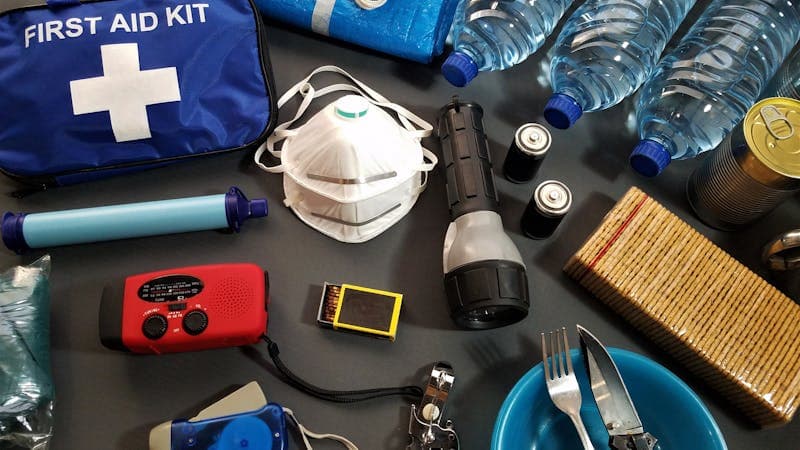
A worked example here is a kit for four people: two adults and two children. Adjust quantities to suit, and scale by the number of people in your household.
Water
One litre per person per day is the absolute minimum for drinking. Comfortable hydration and basic cooking needs two litres. For a family of four over 72 hours, that means 8-12 litres minimum.
Options for stored water: sealed commercial water bottles (cheapest, simplest), water storage containers with a tap (practical for ongoing use), or emergency water pouches with a 5-year shelf life (best for long-term storage without rotation).
Datrex water pouches are what emergency services and the coastguard use. Each pouch is 125ml: enough for a good drink. A pack of 64 gives a family of four a comfortable 72-hour supply and has a 5-year shelf life, meaning no rotation anxiety.
For home storage, I also keep filled water containers in the garage. But the pouches are what goes in the kit bag, because sealed pouches are genuinely portable and rotation-free.
Food
The rule we follows: no cooking required, 2000+ calories per person per day, familiar enough that stressed children will actually eat it.
This is not the place for freeze-dried survivalist rations that require boiling water (you may not have water to spare). Stick to:
- Tinned food you already eat (tuna, beans, soup, fruit) - Peanut butter and crackers - Dried fruit and nuts - Energy bars (check calorie content: most are 200-300 calories, not a meal) - UHT milk (useful for cereal, tea without refrigeration) - Instant porridge sachets (just needs a little cold water, or warm water from a flask)
A good test: would your children eat this without complaint on a normal Tuesday? If not, it does not go in the kit.
First Aid
A proper first aid kit, not a box of plasters. A 100-piece kit that includes bandages, wound dressings, antiseptic wipes, gloves, a foil blanket, and a first aid guide is the right level. Check that yours includes sterile wound dressings for cuts that go beyond what a plaster handles.
More important than the kit: any prescription medications. Keep a two-week supply of any medication your household depends on in the kit, and rotate it so it does not expire. This is the item most people forget and the one that matters most.
Communication and Light
A hand-crank emergency radio is not optional. When the power is out and phone batteries are dead, a radio is how you find out what is happening, when power will return, and whether you need to do anything.
The Midland ER310 does everything you need: hand-crank power so it works without batteries or charge, NOAA weather alert for the US (DAB/FM for UK), a solar top-up panel, and a built-in torch. There is a UK equivalent (the Roberts Play Tough), but the ER310 is the standard recommendation in the US.
Torch: at least one per adult, LED, with spare batteries. Head torches are worth it so hands stay free. Keep batteries in a separate bag inside the kit: batteries corrode and leak if left in a torch for years.
Power banks: two if possible. Kept charged to 80% and rotated every six months. A 20,000mAh bank will charge most phones six or more times: enough for a 72-hour event even with heavy use.
Documents and Cash
This sounds dull but is genuinely important. If you need to leave your home in a hurry (house fire, gas leak, flood evacuation) what you need is:
- Photocopies of passports and driving licences (in a waterproof bag) - Insurance policy numbers - NHS or health insurance card copies - Emergency contact numbers written down (phones die; numbers stored only in phones are useless) - Cash: £100-£200 in mixed notes. Card machines and ATMs do not work when the power is out.
Keep these in a waterproof folder in the kit bag. The originals stay in the house.
Warmth
Emergency foil blankets are almost free, weigh nothing, and are remarkable at retaining body heat. Put one per person in the kit. They are not comfortable but they are effective at preventing hypothermia if you are cold and cannot use your central heating.
Beyond that: a change of warm clothes per person in a vacuum bag (reduces bulk significantly), and waterproof ponchos. In winter, a decent sleeping bag per person is worth having accessible.
What to Skip: The Prepper Traps
The UK and US prepper markets sell a lot of things that serve anxiety more than resilience.
400-piece survival tool kits. The thinking goes: if one multi-tool is useful, a 400-piece kit must be better. It is not. You will never use 390 of those items. A good multi-tool, a fixed-blade knife, and a lighter are enough.
**Five-year freeze-dried meal packs.** These exist for very good reasons in genuine extended emergency scenarios. For a 72-hour kit targeting normal households, they are expensive, require water, and children frequently refuse to eat them. Stick to food you already eat.
Military-grade gear. Military kit is designed for different conditions: soldiers living outdoors for weeks in all weather. Your scenario is a power cut, not a combat deployment.
Gas masks. Unless you are in a specific high-risk occupation or environment, these have no place in a household kit.
More weapons than you need. A kit that prioritises self-defence over water, food, and communication has its priorities wrong. The most dangerous things about a 72-hour power cut are hypothermia, dehydration, and untreated medical issues.
Pre-Built vs Build Your Own: The Honest Trade-Off
Pre-built 72-hour kits exist in a range from approximately £30 to £300. The question is whether they are worth it.
The Ready America 4-person kit is the most commonly recommended pre-built option in the US. It has everything you need for a starting point, is genuinely a family-sized kit, and costs a fraction of assembling equivalent quality components individually.
The limitation: food quality. Pre-built kits typically include survival food bars rather than real food. They are nutritionally adequate but not palatable enough to eat voluntarily, which matters when you are managing stressed children. The water pouches are usually good.
The pragmatic approach: buy a pre-built kit as a base, then supplement it with better food, more water, and your prescription medications. The structural items (torch, radio, first aid, blankets) in most reputable pre-built kits are fine.
If you want to build your own from scratch, you will get better food and better tailoring to your household, but it will take three or four shopping trips and more money. For most families, a pre-built kit that gets augmented is the faster path to being ready.
Where to Store It
Not under the bed. Items under beds get buried under other things, forgotten, and are awkward to access in a hurry.
Best options:
Hall cupboard or under the stairs. Accessible, near the front door (useful if you need to leave), out of the way.
Garage. Good if you can keep it accessible and not buried. The limitation is that garages get cold, which affects some food items and batteries.
One bag, one location, known to everyone. The single most important thing is that everyone in the household knows where it is and what to do with it. If an emergency happens when you are not home, your partner and children should be able to access and use the kit without you.
Label it. Write "EMERGENCY KIT" on it. Do not be subtle about this.
How to Rotate and Maintain It: the January Check
Check the kit in January. It coincides with the cold, dark time of year when the risk of a difficult power cut is highest, and it is easy to remember.
The January check covers:
- Food expiry dates: remove and eat anything within 6 months of expiry, replace it - Water: refill any unsealed containers, check pouches for damage - Batteries: test torches, replace any weak batteries, check power bank charge levels - Prescriptions: confirm medication is in date, replace if expiring soon - Documents: update any that have changed - Children's items: update clothes sizes if they have grown
It takes about 45 minutes and means the kit is always reliable. Most kit failures in real emergencies come from equipment that was not maintained: dead batteries, expired food, outdated documents.
Write the next check date on the bag.
Getting the Kids Involved Without Scaring Them
The framing matters enormously. If you present this as "what we'll do when there is a disaster", children (and frankly, most adults) get anxious. If you present it as routine household maintenance: the same register as testing smoke alarms and checking car tyre pressure: it is normal and unremarkable.
Practical involvement that works with children:
Let a younger child help choose the snacks and pick a torch. Having their own torch, one they chose, is the difference between sleeping through a power cut and being frightened by it.
Let an older child help organise the bag and learn exactly where it is. It gives them a sense of being capable, which is valuable.
Tell them what a power cut is (routine infrastructure failure) and what you would do (use the kit, listen to the radio, eat snacks, probably read a good book). That is the conversation. Not dramatic. Not scary. Practical.
Related Guides
For the water section of your kit, the gravity water filter guide covers your best option for filtering water at home if the mains supply is compromised. For a filter to carry in the bag itself, my LifeStraw vs Sawyer Squeeze comparison picks the one to pack.
For power backup that goes beyond a power bank, the solar generator guide covers everything from the EcoFlow DELTA 2 to budget options.
Frequently Asked Questions
Is a 72-hour kit the same as a bug-out bag?
Not quite. A bug-out bag is specifically designed for leaving quickly: it is optimised for portability. A 72-hour home emergency kit is designed for sheltering in place: staying in your home without external utilities. The contents overlap significantly, but a home kit can include heavier items like water containers and a radio that you would not carry on your back.
How much does a complete 72-hour kit cost?
Starting from scratch: £100-£200 for a family of four, built properly. A decent pre-built kit is £40-£80, then augmented with better food, prescription meds, and a good radio. The radio alone (£30-£60) is the single most valuable item.
Can we use the kit for camping?
Some of it: the first aid kit, torch, emergency blankets, ready-to-eat food items, and water pouches all work. But a camping setup is not a substitute for an emergency kit—camping gear is optimised for different conditions.
What about pets?
Add to your kit: 72 hours of pet food in sealed packaging, water for the pet (using the same water calculation as humans: roughly 50ml per kg of body weight per day for a dog), any medication, and copies of vaccination records. If you have to leave your home, many emergency shelters cannot accept pets, so know your local options in advance.
How do I know if my kit is actually complete?
FEMA and the UK government both publish official emergency kit checklists that are free and sensible (the Red Cross app in the US has a digital version). Cross-reference your kit against one of those once a year. In all of them, the basics are always the same: water, food, first aid, light, communication, warmth, documents.
Not sure what to buy?
Tell me about your home and I'll tell you which resilience gap to close first.
Find My SetupFrequently Asked Questions
What should be in a 72-hour emergency kit?
Water (4 litres per person), 3 days of food that needs no cooking, a hand crank or battery radio, a first aid kit, torches with spare batteries, important documents in a waterproof bag, cash, and any medications. Jeff's full list is in the guide.
How much does it cost to build a 72-hour emergency kit?
A family kit costs around £180 to build yourself over a couple of months. A pre-built family kit from Survival Cat or similar costs £120–£250 and saves the assembly time.
What food should I put in an emergency kit?
High-calorie, long-shelf-life food that needs no cooking or hot water: tinned food, energy bars, crackers, peanut butter, dried fruit. Jeff's guide lists specific products with shelf lives.
How often should I check my emergency kit?
Check it every 6 months — rotating food and water, checking battery levels, updating documents. Doing it when the clocks change makes it easy to remember.
Related Guides
Best Emergency Kit for Families 2026: Pre-Built Bags vs Build Your Own
waterBest Gravity Water Filter 2026: Berkey Alternatives, British Berkefeld, and Sawyer
emergency-kitHow to Make a Family Emergency Plan (And Get the Kids Actually Involved)
educationalThe Complete Home Resilience Guide 2026: Where Jeff Started
emergency-kit72-Hour Emergency Kit Checklist USA: What Your Family of Four Actually Needs
Not sure which guide to read first?
Take the quiz — Jeff will tell you which gap to close first based on your home and budget.
Take the Quiz — It's FreeNo email required