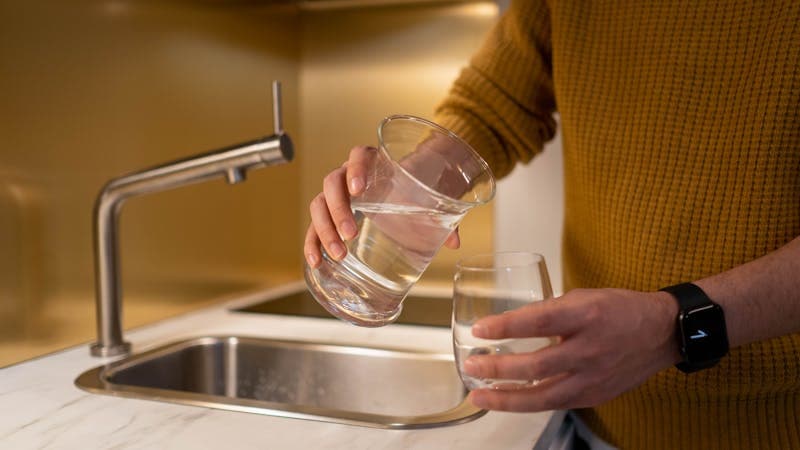
How to Store Drinking Water Long-Term: Containers, Rotation, and What Jeff Learned
Food-grade HDPE containers and 6-month rotation — that's how to store water long term at home. Jeff's containers, schedule, and the year-one mistakes to avoid.

Practical home resilience for normal families. No bunkers, no ideology. Just sensible preparation that saves money and stress when things go sideways.
Just so you know, some links on this page are affiliate links. If you buy something via them, we get a small kickback. You don't pay more, but it helps keep this independent.
Not sure what to buy? Take the quiz.
Find My SetupWater storage is the foundation of home resilience. Not the most exciting topic, I grant you. But it is the one that most people skip, then regret when something actually happens.
There is a reason emergency planning guides lead with water, not food. The human body manages three weeks without food. It manages three to five days without water, and that assumes you are cool, calm, and not physically exerting yourself. In an actual emergency, those conditions rarely apply.
The maths are simple, which is part of why people underestimate how much they need. And the storage solutions are more practical and affordable than most people assume.
This guide covers everything: how to calculate your actual water need, which containers are worth buying, how to treat and maintain your supply, and how to fit this into a home that is not a warehouse.
How Much Water Do You Actually Need
FEMA recommends one gallon (3.8 litres) per person per day. That is the bare survival minimum: drinking and basic sanitation, nothing else.
two gallons (7.5 litres) is a solid household planning figure. The extra half-gallon accounts for cooking, hand washing, cleaning a wound, the fact that children drink more than adults in hot weather, and the general reality that life does not stop being untidy during an emergency.
So for a family of four, planning for a two-week supply:
- Minimum (1 gallon per person per day): 56 gallons / 212 litres - Practical (2 gallons per person per day): 112 gallons / 424 litres
Most people read that and immediately decide two weeks is too ambitious. Fine. Start with three days. That is 12 gallons for a family of four at the minimum rate, or 24 gallons at the practical rate. Achievable within an afternoon.
The point is not to reach some theoretical maximum, but rather to have meaningfully more than nothing and build from there. Stored tap water is also only half the picture; my rainwater harvesting guide covers topping up your supply from the roof rather than the mains.
What Containers Are Actually Safe
Not every container is suitable for water storage. Some will leach chemicals into the water. Others are not structurally suited to sustained storage weight. Here is what matters.
Food-grade HDPE (high-density polyethylene) is the standard. Look for the triangle recycling symbol with the number 2 inside it. This is what the containers below are made from. It does not leach, it tolerates a wide temperature range, and it is structurally sound under sustained liquid weight.
Do not use: thin single-use water bottles (not designed for sustained storage), milk jugs (residual milk proteins breed bacteria rapidly), containers previously used for chemicals or cleaning products, and any container marked with a 1 (PETE): acceptable for single-use water but not for long-term storage.
Do use: thick-walled commercial water containers, 5-gallon water jugs made for water coolers (the blue ones), and the dedicated storage solutions below.
A note on glass: glass is chemically inert and technically excellent for water storage. It is also very heavy, breaks, and is impractical for quantities of more than a few litres. Use it for small quantities if you prefer, but it is not a practical long-term storage solution at household scale.
The WaterBOB: Your Reactive Storm-Prep Tool
The WaterBOB occupies an interesting category. It is not a permanent water storage solution. It is a reactive one: something you deploy when you know an emergency is coming.
When the weather service issues a severe storm warning, a hurricane watch, or any alert that suggests grid disruption: put a WaterBOB in your bathtub. Attach the fill sock to your tap. Turn on the water. In 20 minutes you have a 100-gallon food-grade reservoir in your bathtub.
That is 25 days of water at the minimum rate for a family of four. From one bathtub, in 20 minutes, for around £25.
The WaterBOB is single-use: it is a bladder you fill once and drain, not meant to sit filled for six months. But as a rapid-deployment tool it is genuinely clever—water stays fresh for up to 16 weeks, the hand pump lets you access it without electricity, and the plastic is BPA-free and food-grade.
Its key value is reactive deployment: you need to have the WaterBOB before the storm, obviously, which means buying it now and keeping it in the linen cupboard. At that price, keeping two (one per bathtub if you have them) is reasonable.
What the WaterBOB does not replace: permanent stored water. If an emergency arrives with no warning, or a problem develops gradually rather than dramatically, you need water already stored. That is what the permanent solutions below are for.
The 55-Gallon Stackable Tank: The Long-Term Workhorse
For permanent home water storage in the US, a 55-gallon food-grade tank is the standard recommendation. Of the options currently available, the WaterPrepared stackable design is the one I would buy for most households, for one specific reason: the built-in spigot.
Accessing water from a traditional barrel requires a siphon pump. A siphon pump is another thing to own, maintain, and locate in an emergency. The WaterPrepared tank has a standard garden-hose spigot integrated into the design. Turn the tap, fill a jug. No pump required.
The stackable design is the other advantage. Two 55-gallon tanks side by side take 22" × 56" of floor space. Two of the same tanks stacked take 22" × 28" of floor space. For a garage, utility room, or storage area, that difference matters.
At 55 gallons, one tank gives a family of four 13 days at the minimum rate or 6-7 days at the practical rate. Two tanks gives a family of four a full two-week minimum supply, or a week of comfortable-level storage. That is a realistic target.
Fill from your mains tap, add treatment (see the section on treating your water below), seal, label with the fill date, and store in a cool dark location. Check and refill every 12 months or after any emergency where you used the water.
A practical note on filling: 55 gallons is approximately 460 pounds of water. Position the tank where you want it before you fill it. It is not moving once full. If you need to put it in the garage and your outside tap is around the corner, plan the hose route before you start.
The Traditional Barrel: Augason Farms Option
The Augason Farms barrel is the more traditional alternative: closed-top, dual-plug fitting, no spigot. If you prefer a tighter sealed design, or want the kit version that includes the treatment solution and siphon pump, this is a solid option.
The practical difference from the WaterPrepared tank is operational. To get water out: you remove the small plug from the top fitting, insert the siphon pump tube, and pump. More steps than turning a spigot, but some people prefer the fully sealed nature of the dual-plug design for long-term storage.
Augason Farms is a well-established brand with a large user review base, offering barrels in BPA-free food-grade polyethylene. The kit version (which adds treatment drops, a siphon pump, and a bung wrench) costs more but means you have everything you need in one purchase.
Which barrel to choose? If operational simplicity matters most to you, the WaterPrepared spigot design. If you prefer the sealed dual-plug traditional barrel approach, the Augason Farms option. Both will store water safely for years.
How to Treat Your Stored Water
Here is something that surprises people: treated tap water from a municipal supply is already clean enough to store. The chlorine added during treatment acts as a preservative. You do not need to filter it before storing.
Municipal chlorine levels do vary, though, and water sitting in a sealed container for 12 months does gradually lose its chlorine content. To ensure your stored water remains bacteriologically safe throughout its storage period, add additional treatment at the point of filling.
Option 1: Unscented liquid bleach. Use standard household sodium hypochlorite bleach: unscented, no additives. Add 8 drops per gallon (2ml per 4.5 litres). This is the FEMA-recommended approach. Use a measuring syringe or an eyedropper. Label the container with the fill date.
Option 2: Purpose-made water treatment tablets.
Aquatabs are the water purification tablet used by FEMA, the Red Cross, and international aid organisations. One 49mg tablet treats one litre of clear water. For a 55-gallon drum, you would need approximately 200 tablets: about seven packs. More expensive than bleach per gallon, but precisely dosed and foolproof for people who do not want to measure bleach.
One thing Aquatabs do not do: remove chemical contaminants, heavy metals, or sediment. They are a disinfection treatment, not a filtration system. For clear municipal tap water going into food-grade containers, they are exactly right. For treating water from an unknown source during an actual emergency, use Aquatabs in combination with a gravity water filter.
The 30-tablet travel packs are useful for the 72-hour kit. Buy larger packs for treating storage drums.
Where to Store Your Water
Storage location matters more than most guides acknowledge.
Temperature: Water does not need to be refrigerated, but it should not be stored in locations that get very hot. Prolonged high heat does not make the water unsafe, but it can cause plastic containers to off-gas trace compounds over time. A garage that reaches 120°F in summer is a less-than-ideal storage location for the long term. A cool, dark interior space is ideal. A well-ventilated garage that stays below 85°F most of the year is fine.
Light: Keep water away from direct sunlight. UV encourages algae growth even in treated water.
Chemical proximity: Do not store water containers near petrol, solvents, pesticides, or cleaning chemicals. These chemicals can permeate through HDPE over time. The utility shelf that also holds the lawnmower fuel is not the right place.
Elevation: Store containers off concrete floors where possible. Concrete can be porous, and while HDPE is resistant, off-floor storage on a wood pallet or shelf is a simple precaution that also protects the containers from physical damage.
Practical storage configurations that work:
A corner of the garage on a wooden pallet, away from chemicals, with the WaterPrepared tanks stacked. A utility room shelf, with smaller 5-gallon containers that can be carried to a kitchen in an emergency. A basement space, which is typically ideal (cool, dark, stable temperature). Under a staircase: a surprisingly good location that uses otherwise dead space.
Rotation: The Annual Water Audit
Stored water does not technically expire in the same way food does. What changes over time is the chlorine content that keeps it bacteria-free. Properly treated, sealed water in food-grade containers is generally considered safe for 12 months. After that, re-treating or replacing is sensible practice rather than a hard rule.
My protocol: I rotate storage water once a year, timed with the annual emergency kit check in January.
The process: open the barrel or tank, connect a hose, drain the water into the garden (treated water is fine for plants at these concentrations), give the container a quick rinse with clean water, refill from the mains tap, add treatment, reseal, and write the new fill date on the container with a marker. For a 55-gallon tank, this takes about 30 minutes.
Use drained rotation water productively where you can. Water the garden. Fill up the paddling pool. Use it for washing cars or outdoor furniture. The point is not to waste it.
Label every container with the fill date and the next rotation date. Make it visible. Do not rely on memory.
The Five-Gallon Container System: The Flexible Alternative
Not everyone has the space or inclination for 55-gallon drums. The alternative is multiple 5-gallon (18-litre) food-grade containers: the heavy blue water jugs used by water coolers.
These have practical advantages for some households:
- Carriable by one person: relevant if you might need to move quickly - Stackable on shelves: fits inside a wardrobe or utility cupboard - Refillable at water cooler stations in many supermarkets - Easier to rotate incrementally rather than all at once
The disadvantages: more seams and caps mean slightly more potential for leakage over time. More containers to track, fill, and label. Higher cost per gallon of storage capacity than a single large tank.
For households without garage access, or families who prefer modular storage, a set of 5-10 five-gallon containers stored in a wardrobe or utility room is entirely viable. At 5 gallons each, eight containers gives a family of four 10 days at the minimum rate: a meaningful supply in an awkward space.
Building Your Water Storage Plan
The practical question is not whether to store water. It is how to get from nothing to something without it becoming a project that never starts.
My suggested sequence:
Week 1 (today, honestly): Fill 10-15 clean 2-litre bottles from the tap and put them under the sink. Add 4 drops of bleach per litre if you want them treated for long-term storage, or plan to rotate them every 6 months without treatment. This takes 15 minutes and gets you a three-day supply immediately.
Month 1: Order a WaterBOB and put it in the linen cupboard. It is a storm-prep tool: you want it before you need it.
Month 2-3: Order one WaterPrepared 55-gallon tank or equivalent. Position it in the garage or utility space before it arrives. Fill it on delivery day. Treat and label.
Month 6: Assess. Do you want more? Order a second tank. You now have a genuinely significant long-term supply.
The goal is progress, not perfection. Three days of stored water is infinitely better than none. The 2-litre bottles step is genuinely available to almost everyone, today, for free. Start there.
Related Guides
If your stored water supply is compromised or you need to treat water from an uncertain source, the best gravity water filter guide covers your options for filtering water at home without electricity or plumbing.
For understanding the full range of water purification options (including boiling, filtration, and chemical treatment) see the water purification methods guide.
Frequently Asked Questions
Can I store water in old milk jugs?
No. Milk proteins embed themselves in the HDPE plastic in a way that is nearly impossible to remove entirely. Even after thorough washing, residual milk proteins provide a substrate for bacterial growth. Use containers that held water or food-safe liquids only. The opaque white HDPE used in milk jugs is also thinner than proper water storage containers and not suitable for long-term storage.
Do I need to store bottled water, or can I just store tap water?
Treated tap water is fine for storage. Commercial bottled water in sealed containers is also fine, but at $1-2 per bottle for single-use plastic it is significantly more expensive per gallon than filling your own food-grade containers from the tap. The water is not meaningfully safer.
How long does stored water actually last?
In properly sealed, food-grade containers with adequate chlorine treatment, stored water remains safe for 12 months. Commercially bottled water is typically dated 2 years, but this is a manufacturer's recommendation, not a sharp safety threshold. If water smells normal, is clear, and has been stored correctly, it is safe.
Can my water storage freeze in winter?
Yes. Water in containers will freeze below 32°F, which can rupture containers if they are completely full. Leave a small air gap at the top of containers in cold storage locations, or move containers to a heated space before temperatures drop below freezing.
Do I need to filter my stored water before drinking it?
If you stored treated tap water correctly in clean containers, no. If you have any doubt about contamination (the container was damaged, the storage location had a chemical spill), run the water through a gravity filter before drinking.
Not sure what to buy?
Tell me about your home and I'll tell you which resilience gap to close first.
Find My SetupFrequently Asked Questions
How long can you store tap water?
Tap water can be stored for 6–12 months in sealed, food-grade containers in a cool, dark location. Rotating stored water every 6 months is standard practice.
What containers are best for storing water?
Food-grade HDPE containers are the standard — a mix of 25-litre stackable WaterBrick containers and commercial 5-litre bottles works well. Avoid milk jugs and soft drink bottles — they degrade.
Do you need to add bleach to stored water?
Only for untreated water sources (rainwater, rivers). Mains tap water already contains enough chlorine to remain safe for 6–12 months in sealed containers. No additives needed for most household storage.
Related Guides
How Much Water Should Your Family Store? The Real Calculation
waterBest Gravity Water Filter 2026: Berkey Alternatives, British Berkefeld, and Sawyer
waterWater Purification Methods Compared: Filters, Tablets, Boiling, and UV
educationalThe Complete Home Resilience Guide 2026: Where Jeff Started
waterHow to Store Drinking Water Long-Term: US Containers, Rotation, and What Jeff Learned
Not sure which guide to read first?
Take the quiz — Jeff will tell you which gap to close first based on your home and budget.
Take the Quiz — It's FreeNo email required