Best Winter Car Emergency Kit 2026: The NWS List Plus Four Upgrades That Matter
The best winter car emergency kit is a NOCO GB40 jump starter, a wool blanket, and the NWS survival list in one duffel. Jeff builds it for US drivers.

Practical home resilience for normal families. No bunkers, no ideology. Just sensible preparation that saves money and stress when things go sideways.
Some links here are affiliate links. If you buy through one, I earn a small commission at no extra cost to you. It never changes what I recommend.
A dead battery in a grocery store parking lot is an errand. The same dead battery on a rural shoulder at 10°F with the light fading is an emergency, and the difference between the two is what is in your trunk. Build the kit around a NOCO Boost GB40 jump starter and a real wool blanket, add a premade roadside kit for the tools you hope never to touch, and the worst drive of your winter turns into a twenty-minute story you tell later.
The National Weather Service counts, on average, more than 5,000 deaths and more than 418,000 injuries from weather-related vehicle crashes every year, and its winter preparedness guidance is blunt about the fix: winterize the vehicle before the season starts and carry a winter survival kit in it. This guide takes the official NWS list, explains what each item is actually for, and upgrades the handful of items where a specific product genuinely earns its place.
I will be straight about my method: I have not spent a night stranded in a Minnesota snowbank. What follows leans on the NWS list, manufacturer specifications, and what drivers in cold states consistently report in owner reviews and forums like r/VEDC about which gear still works when the temperature drops. Where a figure is a published standard or a maker rating, I say so.
What Should Be in a Winter Car Emergency Kit
The short answer: the NWS Winter Storm Survival Kit list, plus four upgrades (a lithium jump starter, a wool blanket, a proper folding shovel, and chemical hand warmers) that turn the checklist from adequate into comfortable.
Here is the official NWS list, with the job each item is doing:
| NWS kit item | What it is actually for |
|---|---|
| Mobile phone, charger, batteries | Calling for help and telling someone where you are |
| Blankets or sleeping bags | Surviving hours of cold without running the engine |
| Flashlight with extra batteries | Working after dark without draining your phone |
| First aid kit | Treating injuries when help is slow in bad weather |
| Knife | General purpose cutting, from seatbelts to packaging |
| High-calorie, non-perishable food | Staying fueled and warm while you wait |
| Extra clothing to keep dry | Dry layers after digging or walking, wet kills warmth |
| Large empty can, tissues, paper towels | Emergency toilet when you cannot leave the car |
| Small can and waterproof matches | Melting snow for drinking water |
| Sack of sand or cat litter | Traction under drive wheels on ice |
| Shovel | Digging out wheels and clearing the exhaust pipe |
| Windshield scraper and brush | Keeping glass clear enough to drive |
| Tool kit, tow rope, booster cables | Getting moving again with a helping vehicle |
| Water container | Carrying drinking water that is not frozen solid |
| Candle and matches | Light, and in a real emergency, lifesaving heat |
| Compass and road maps | Navigating when your phone battery is gone |
Most of that list is stuff you already own. Gather it into one duffel this weekend and you are ahead of most drivers on the road. The rest of this guide covers the items worth buying properly.
Is a Premade Car Emergency Kit Worth Buying?
Yes, as a base layer, as long as you treat it as the starting point rather than the finished kit. A premade kit solves the real problem, which is that assembling cables, a triangle, a tow strap, gloves, and a first aid kit separately is the kind of errand that never actually happens.
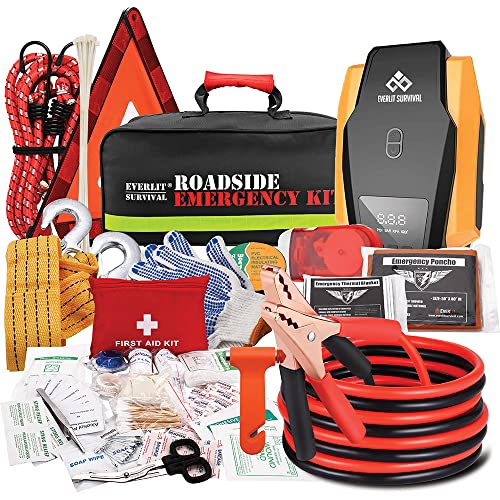
The Everlit kit is the one I would start with. It packs 12-foot 8-gauge jumper cables, a digital tire inflator with auto shutoff, a tow strap, a 108-piece first aid kit, a reflective warning triangle, a glass breaker with seatbelt cutter, work gloves, a rain poncho, and a space blanket into one zipped bag. It is run by a veteran-owned outfit, and the inflator alone earns the trunk space: a slow leak on a cold morning becomes a five-minute fix instead of a roadside tire change.
The honest limits: the included space blanket is a foil sheet, not something you want to spend six hours under, and the flashlight is serviceable rather than good. That is what the upgrades below are for. Premade kits are judged by their weakest items; this one is judged fairly as a strong chassis that needs a better blanket and better light added to it.
The Jump Starter: The Single Best Winter Upgrade
A lithium jump starter is the one item that converts the most common winter failure (a battery killed by cold) from needing a rescuer into needing ninety seconds. Cold is brutal on batteries: a battery that cranked fine in October dies in the first real cold snap, usually in the least convenient place possible.

The NOCO Boost GB40 is the pick you see named again and again in owner forums and r/VEDC jump-starter threads, and the maker's numbers explain why: 1,000 peak amps, rated for up to 20 starts per charge, on engines up to 6.0L gas or 3.0L diesel, in a 2.5-pound package that fits a glovebox. The clamps are spark-proof with reverse polarity protection, which matters at 6 a.m. in the dark when you are clipping leads with cold fingers. It doubles as a USB power bank for your phone and carries a 100-lumen flashlight with an SOS mode, so it quietly covers three slots on the NWS list at once.
One piece of ownership honesty that owners flag and the chemistry backs up: lithium packs lose punch in deep cold and self-discharge slowly in storage. Top it up every couple of months (it recharges in about 3 hours), and during brutal cold spells bring it indoors overnight or warm it in your jacket for a few minutes before using it. A jump starter you charged in November and ignored is a paperweight by February.
Booster cables still belong in the kit as the backup that never runs out of charge, which is why the Everlit kit above earns its place even with a GB40 in the glovebox.
The Blanket: Wool, Not Foil
If the car will not start and help is an hour out, the heater is off and the cabin cools fast. This is the scenario where the difference between a foil space blanket and a real blanket is the difference between miserable and fine.

The Arcturus military wool blanket is the upgrade: 64 by 88 inches, 4.5 pounds, an 80 percent wool weave that keeps insulating even when damp, which synthetic throws and foil sheets do not. Wool is also naturally fire-retardant, and Arcturus states these are never treated with added flame-retardant chemicals. It is triple-washed at production and machine washable after, so it can live in the trunk year-round and still be welcome at a tailgate or on the couch.
Keep the foil space blanket from the premade kit too. The right stack for a long cold wait is foil against the seat to reflect heat, wool on top of you, and hand warmers inside the layers.
The Shovel and Traction: Getting Unstuck
Being stuck in snow is usually a ten-minute problem with the right two items and an all-night problem without them. The method is simple: dig the snow away from the drive wheels and the exhaust pipe, throw traction material under the drive wheels, and pull away gently.

The AstroAI folding shovel covers the digging half properly. It runs an aluminum alloy blade on a three-stage telescoping handle, extends to 38.4 inches so you can actually lever snow rather than paw at it, and folds to 23 inches to disappear into a trunk corner. The D-shaped handle works with gloves on, and the blade edge breaks thin crust ice, though AstroAI itself says to use a dedicated ice breaker for thick ice, which is the kind of honesty I like in a spec sheet.
For the traction half, skip the specialist boards and do what the NWS list says: a sack of non-clumping cat litter or sand in the trunk. It costs almost nothing, doubles as weight over the drive axle in a rear-wheel-drive car, and never breaks. Pour a line of it directly in front of each drive wheel before you try to move.
Hand Warmers: The Morale Item That Is Secretly Safety Gear
Cold hands stop working, and hands that do not work cannot clip jumper leads, thread a tow strap, or text your location. Chemical hand warmers are the cheapest fix in the entire kit.

HotHands warmers are the standard: air-activated iron-powder packets rated by the maker for up to 10 hours of heat, and a 40-pair box covers a family's whole winter. Keep ten pairs in the car kit and the rest in the house for power cuts, football games, and school runs. They have a shelf life of years, no batteries, no flame, and they work inside gloves and boots where no other heat source can.
They are also the item that makes the difference for kids in the back seat during a long cold wait, which is worth more than any spec.
The Four Upgrades at a Glance
One sentence of orientation: these four items are what separate a kit that technically exists from a kit that gets you home, and each lives where you can reach it.
| Upgrade | Job it does | Key spec (maker figures) | Where it lives |
|---|---|---|---|
| NOCO Boost GB40 | Restarts a cold-killed battery without a second car | 1,000A peak, up to 20 starts per charge, 2.5 lb | Glovebox or console |
| Arcturus wool blanket | Keeps you warm through a long wait, even damp | 64 x 88 inches, 80% wool, 4.5 lb | Trunk duffel |
| AstroAI folding shovel | Digs out drive wheels and the exhaust pipe | 38.4 inches extended, folds to 23 inches | Trunk corner |
| HotHands warmers | Keeps hands working and morale up | Up to 10 hours of heat per pair | Duffel pocket, plus the house |
What About Food, Water, and the Radio?
Keep it boring and freeze-tolerant. High-calorie bars (the NWS list says high-calorie, non-perishable food, and granola or protein bars qualify) handle freezing fine; swap them each spring. For water, remember a bottle in a January trunk is a brick: carry plastic bottles, never glass, part-filled so expansion does not split them, and rotate them with the food. The NWS list's small can and waterproof matches exist because melting snow is the fallback when your bottles are solid.
For staying informed, your phone is the primary tool, which is why the kit carries a charger and the GB40 doubles as a power bank. A dedicated crank weather radio like the Midland ER310 earns its place on long rural drives and storm-season road trips.
And before any long winter drive, do the two free things the NWS tells drivers: keep the gas tank near full (it prevents ice forming in the tank and fuel lines, and it is your heater reserve if you are stuck), and call 511 for road conditions before you leave. Every state runs that service.
The Candle Question
The NWS list includes a candle and matches for light and, in its words, lifesaving heat in a real emergency. A single candle in a metal can raises cabin temperature a surprising amount. If you carry one, carry it with respect: crack a window for ventilation, keep it in a can so it cannot tip, and never fall asleep with it burning. The wool blanket and hand warmers are the safer first answers; the candle is the deep reserve.
What to Avoid
A few things that look like preparedness and are not:
No-name jump boxes with heroic amp claims. The amp figures on unbranded boxes are routinely optimistic, and a jump starter that overstates its numbers fails on exactly the morning it was bought for. Stick to brands whose ratings owners have actually tested against cold engines.
Clumping cat litter. It absorbs water and turns to slush on ice, which is worse than nothing. Traction needs the non-clumping kind, or coarse sand.
Cotton blankets and throws. The old outdoor rule that cotton stops insulating the moment it gets damp holds in a cold car. Wool or nothing, with the foil sheet underneath you rather than instead.
Glass bottles for water. A frozen glass bottle is broken glass in your kit. Plastic, part-filled.
Storing everything, including the jump starter, in the trunk. The trunk is the coldest part of the car and the part most likely to be iced shut or buried. The grab-first items belong in the cabin.
The wait-for-the-forecast plan. Winter gear is a buy-ahead category. The week the first storm is named is the wrong week to go shopping for a shovel, and the wrong morning to discover the jump starter was never charged.
How to Pack It All
One duffel bag in the trunk, packed in reverse order of urgency: the premade kit at the bottom, clothing and blanket in the middle, and the things you grab first (jump starter, hand warmers, flashlight) in the outside pocket. The GB40 ideally rides in the glovebox or center console instead, both because cabin temperature is kinder to the battery and because the trunk may be iced shut or buried the day you need it.
Check the kit twice a season: top up the jump starter, swap the food and water, and put back whatever migrated into the house over the summer. The clocks changing works as the reminder, the same trigger the stored water rotation guide recommends.
Related Guides
72-hour emergency kit for US households is the house-side version of this kit, built on the same logic.
What to do in a power outage covers the storm scenario where you are home instead of driving.
Build It This Weekend
Here is the verdict one last time: start with the Everlit kit as the chassis, add the Arcturus blanket, the AstroAI shovel, a box of HotHands, and a bag of cat litter, and put a NOCO Boost GB40 in the glovebox. That is one online order and one errand, and between them they cover the hard-to-source half of the NWS survival list; the rest is already in your house. The first time you clip those spark-proof clamps onto a dead battery in a dark parking lot and the engine turns over, the whole kit will have paid for itself in a single morning.
Frequently Asked Questions
What should be in a winter car emergency kit?
Start with the National Weather Service survival list: blankets, a flashlight with spare batteries, a first aid kit, high-calorie non-perishable food, water, extra dry clothing, a shovel, a windshield scraper, sand or cat litter for traction, a tow rope, booster cables, and a charged phone with a charger. Then add the four upgrades that matter: a lithium jump starter, a wool blanket, a folding shovel, and chemical hand warmers.
Are premade car emergency kits worth buying?
Yes, as a base layer. A good premade kit solves the errand nobody does: collecting cables, a tire inflator, a tow strap, a warning triangle, and a first aid kit in one bag. Judge it as a chassis, then upgrade the two items premade kits always skimp on, the blanket and the light.
Do lithium jump starters work in cold weather?
Yes, with one habit attached. Lithium packs lose some punch in deep cold and slowly self-discharge in storage, so top the unit up every couple of months and keep it in the glovebox rather than the trunk. In a brutal cold snap, bring it indoors overnight or warm it inside your jacket for a few minutes before you clamp on.
Will bottled water freeze in my trunk?
In a proper cold snap, yes. Carry plastic bottles only, part-filled so the ice has somewhere to expand, and rotate them with the food each season. The NWS list includes a small can and waterproof matches precisely so you can melt snow for drinking water if your bottles are solid.
Is cat litter or sand better for winter traction?
Either works, and both beat specialist gadgets for the money. Use non-clumping litter or coarse sand, poured in a line directly in front of the drive wheels. Clumping litter absorbs water and turns to slush, which is worse than nothing on ice.
Where should I keep the jump starter in the car?
Glovebox or center console, not the trunk. Cabin temperatures are kinder to the lithium cells, and the day you need it may be the day the trunk is iced shut or buried. Keep the heavy duffel with everything else in the trunk.