Best Indoor-Safe Heater for a Winter Power Outage (2026): Heat and Light That Work Without the Grid
The Mr. Heater Portable Buddy is the best indoor-safe heater for a power outage: 9,000 BTU, no electricity, low-oxygen shutoff. Plus the CO rules that matter.

Practical home resilience for normal families. No bunkers, no ideology. Just sensible preparation that saves money and stress when things go sideways.
Some links here are affiliate links. If you buy through one, I earn a small commission at no extra cost to you. It never changes what I recommend.
The power goes out in a January storm and the house starts cooling immediately. Within a few hours the question stops being comfort and starts being whether the pipes hold. The answer that actually works without the grid is a radiant propane heater, and the Mr. Heater Portable Buddy is the one to own: 9,000 BTU of heat, no electricity at all, and a low-oxygen shutoff built in. Buy it with a carbon monoxide alarm, and pick up a stack of 1 lb propane cylinders locally, because the heater is only safe with the alarm there too, and the 1 lb cylinder is the only fuel setup its manual clears for indoor use.
Before anything else, the number that should shape how you read this guide: the CDC reports that more than 400 Americans die every year from unintentional carbon monoxide poisoning not linked to fires, more than 100,000 visit an emergency department, and more than 14,000 are hospitalized. Winter outages are when people improvise heat, and improvised heat is what fills those statistics. Everything below is built to keep you warm without joining them.
My method, stated plainly: I have not run a CO meter in a sealed room with a propane heater burning. Every safety figure here comes from the manufacturer's own manual for the heater in question or from CDC guidance, quoted and attributed where it appears. Where the manual and the marketing copy disagree, I go with the manual and say so.
What Actually Heats a House With No Electricity?
Burning fuel. That is the honest short answer, and it is why this guide is mostly about doing that safely rather than about gadgets.
Electric heat is the thing people reach for first and it is the one option that cannot work on battery power. A plug-in space heater draws about 1,500 watts on high. Run that from a 1,056Wh battery like the Anker SOLIX C1000 and the arithmetic gives you roughly 42 minutes before the battery is flat, and rather less once inverter losses are counted. On the heater's low setting, about 750 watts, you get a little under an hour and a half. That is not a heating plan, it is a demonstration.
The propane heater on this page puts out about 2,600 watts of heat on its high setting, which is more than the electric heater manages on high, and the manual's own figure is roughly 3 hours per 1 lb cylinder at that setting. Three hours does not sound like much next to a battery's 42 minutes until you notice the difference that matters: you can stack a dozen cylinders where the manual allows, and you cannot stack kilowatt-hours anywhere. Fuel stacks. Battery capacity does not, and a dead grid will not recharge it.
This is the single most common mistake in outage-prep content: treating a power station as a heat source. Batteries are brilliant for lights, phones, routers and fridges, all of which sip power. Resistive heat is the one load that eats a whole battery in under an hour. Buy a battery for the things that keep your household running, and buy fuel for heat.
The Tiered Plan: What to Buy First
Here is the orientation in one sentence: the tiers below go in order of what you will actually reach for, and the first one costs nothing.
| Tier | What it covers | Kit | Why it is in this position |
|---|---|---|---|
| 1. No fuel, no power | Holding body heat for the first hours | Wool blankets, layers, hand warmers, one closed room | Works instantly, zero risk, zero running cost |
| 2. Light and comms | Seeing, charging, hearing warnings | LED lanterns, battery radio, power station | Low power draw, so a battery genuinely covers it |
| 3. Real heat | Keeping a room liveable while you are awake in it | Indoor-rated radiant propane heater, a CO alarm, 1 lb cylinders | The simplest option that makes heat without the grid |
| 4. Whole-house | Running the furnace itself | Permanently installed generator, professionally fitted | Different budget and a different guide |
Most households stop at tier 3 and that is the right call. Tiers 1 and 2 are cheap and immediate, and they are also what carries you through the night, because tier 3 is explicitly not an overnight solution.
Tier 1: Close One Room and Hold Your Heat
Before you light anything, shrink the problem. Pick one room, preferably small, south-facing if you have the choice, and away from the worst of the wind. Close the doors to everywhere else. Hang a blanket over a drafty doorway. Keep the curtains open while the sun is on that side of the house and shut them the moment it is not.
The kit for this tier is the cheapest in the guide and it matters more than people expect, because it is the tier that works while you sleep.

Wool is the material that keeps insulating when it is damp, which is why it belongs in a cold house rather than a synthetic throw. A heavy wool blanket over your legs in a chair is worth more than a degree or two of air temperature.

Chemical warmers are rated by the maker for up to 10 hours per pair, need no power and no flame, and work inside gloves, boots and pockets where nothing else reaches. They are iron-oxidation pads: they burn nothing and produce no carbon monoxide, which is why they are the one heat source in this guide with no safety section attached. They are also what makes a cold evening tolerable for children, which matters more to how an outage goes than any spec sheet.
Do the plumbing jobs now too, while you can still see: open the cabinet doors under sinks on exterior walls so household heat reaches the pipes, and if the house is going to drop near freezing, let a tap drip.
Tier 2: Light and Information
Light is the thing that changes the mood of an outage, and it is cheap.

A four-pack of battery lanterns means one per room rather than one shared torch: 350 lumens each, 30 LEDs, and they run on AA cells you already have. The reason I prefer a lantern pack to candles is unglamorous. Candles are a fire risk in a house full of blankets and tired people, and a lantern you can hand to a child is worth four candles you have to supervise.
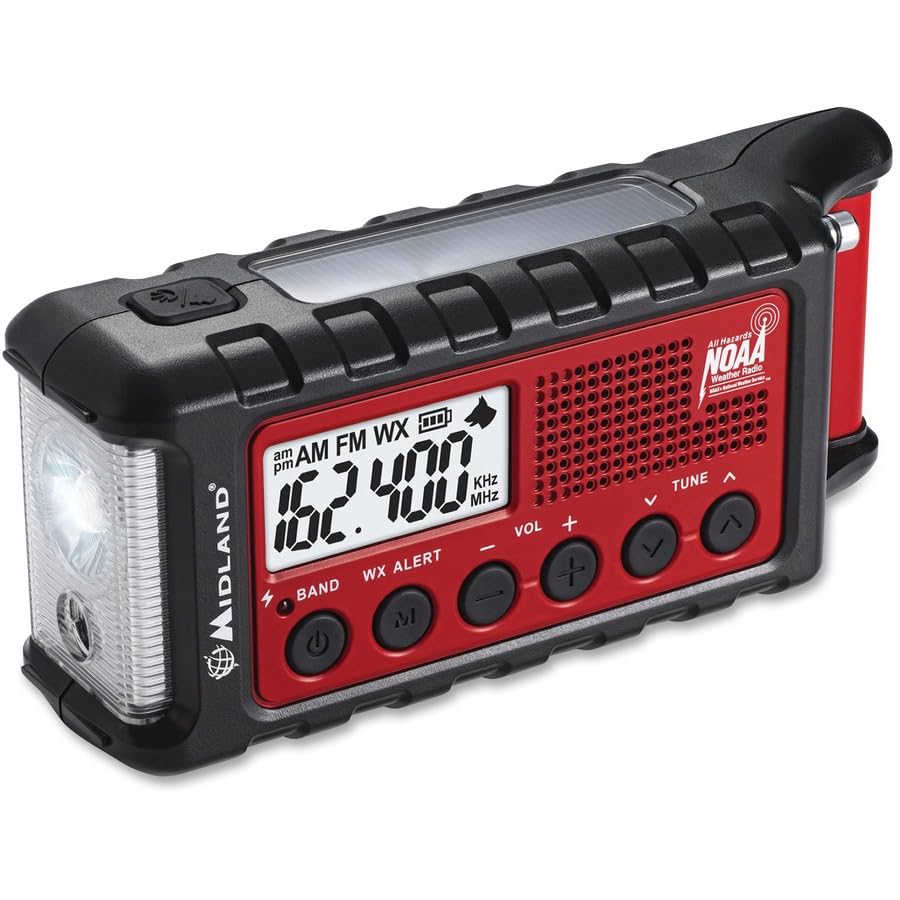
A hand-crank NOAA weather radio is how you find out when the utility expects power back and whether another front is coming, without spending phone battery. The ER310 also charges a phone off its crank, which is the kind of redundancy that earns its shelf space once a decade and is priceless that once.

The power station is for the loads a battery is actually good at. A 1,056Wh LiFePO4 unit with 1,800W output will keep phones, a router and lamps running for a day or more, and it will cycle a modern fridge through an outage comfortably. A CPAP at roughly 40 watts will run through a night on it. Be careful about generalising that to all medical kit, though: a home oxygen concentrator draws several hundred watts continuously, which is a few hours from this battery rather than a night, so anyone who depends on one needs a plan agreed with their supplier rather than a power station and hope.
Tier 3: The Indoor-Safe Propane Heater
This is the tier that makes real heat, and it is also the tier where the rules stop being advice and start being the difference between warm and dead. Read this whole section, and the rules section after it, before you buy anything.

The Mr. Heater Portable Buddy is the pick for most homes. It runs 4,000 or 9,000 BTU of radiant heat with no electricity at all, and it carries what Mr. Heater calls its Life Safety System: a low-oxygen shutoff, a tip-over shutoff and self-extinguishing protection. Mr. Heater states it is designed and approved for indoor and outdoor use, and its listing rates it for spaces up to 225 square feet.
The fuel rule that most roundups get backwards. The manual is specific about which fuel setup is cleared for which situation, and it is not the one you would guess from the marketing. For indoor use it says the heater "may be used for emergency indoor heating when connected to a disposable 1 lb. propane cylinder." The big refillable cylinder is a different case entirely: the heater "may be used in a recreational enclosure with a remote refillable propane cylinder ONLY when the cylinder is located outdoors," and only with Mr. Heater hose No. F273701, F273702 or F272702 and fuel filter F273699. The manual states the reason in a DANGER box: "NEVER bring a refillable propane cylinder indoors. A fire or explosion can occur causing property damage, serious injury or death!"
So the indoor plan is 1 lb disposable cylinders, and the 20 lb barbecue bottle is not an indoor item at any time, stored or running. If you want the long-runtime setup, the bottle lives outside and the hose comes in through an opening, which is the arrangement the manual describes for cabins, trailers and enclosed porches.
Runtime, honestly. The headline numbers you see quoted are the low-setting ones. The manual's own range is "approximately 3 to 6 hours on a one 1lb cyclinder and 48 to 110 hours on a 20 lb cylinder (based on 'HI' and 'LO' settings)." The generous end of each range is the 4,000 BTU setting and the short end is 9,000 BTU. On raw energy content a 1 lb cylinder works out nearer two and a half hours on high than three, so treat the manual's 3 hours as the optimistic case and the listing's 5.4 hours as the low setting it actually describes. The manual also warns that "runtimes can be significantly reduced when operating continuously at temperatures below 20ºF," which is the weather this guide exists for, and the spec table puts the minimum ambient temperature at 0°F.
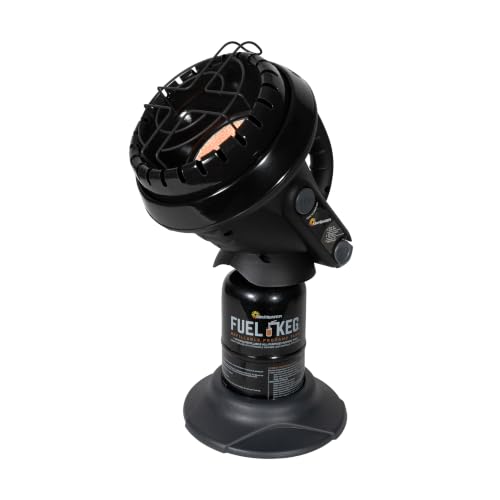
For a single closed room the Little Buddy is the better size at 3,800 BTU, rated by Mr. Heater for up to 95 square feet, with 5.6 hours on a 1 lb cylinder from its single heat setting. Undersizing is the safer error with unvented heat: a heater matched to its room gets run properly, where an oversized one gets throttled down behind a shut door.
One important caveat on this one. The safety figures in the next section are quoted from the Portable Buddy manual, and the Little Buddy is a different model with its own manual and its own numbers, including a different ventilation figure. Read the manual that comes in the box rather than assuming the larger heater's rules carry across. And if you rent or live in a multi-family building, check your lease and your local code before you buy either: unvented fuel-burning heaters are restricted in a lot of apartment housing, and your neighbour's sealed apartment is not yours to ventilate.
Where these heaters are not allowed indoors at all. Mr. Heater's listing states that indoor use is not approved in Canada or Massachusetts, and the manual adds a third jurisdiction that the listing does not mention: "NOTICE: Not for use in a 'dwelling home' in California." If you are in any of those three, there is no indoor-approved version of this heater for you to buy instead. The separately sold Massachusetts and Canada variants are sold as outdoor-use-only versions, because unvented portable heaters are not permitted indoors in either jurisdiction. Nothing in this guide's indoor advice applies to you, and tiers 1 and 2 are where your plan has to live.
The Rules That Make a Propane Heater Safe Indoors
These come from the Mr. Heater Portable Buddy owner's manual itself (model MH9BX / F232000; the Midnight Series unit above lists identical ratings, but the manual in its box is what governs it), not from me. The manual is blunt in a way marketing copy never is.
It is an unvented heater, and the manual says so on its first page: "This is an unvented gas-fired portable heater. It uses air (oxygen) from the area in which it is used." That one sentence is the whole safety model. The heater is consuming the air in your room.
Ventilation is mandatory, both openings go outside, and there is a number. The manual states the heater "requires a minimum vent area of 9 square inches, (example 3" x 3" opening) at the ceiling and at floor level for adequate ventilation during operation." Two openings, one high and one low, and both must open to outside air. On a double-hung window, an inch at the top and an inch at the bottom does it. If your windows do not open that way, you need two separate openings to outside before you light it. A gap under an interior door does not count: it moves depleted air around inside the same sealed house instead of bringing fresh air in. The manual's governing principle is stated for enclosures: "If the recreational enclosure does not have a window or roof vent, DO NOT USE THIS HEATER INSIDE."
Check for leaks every single time you connect a cylinder. The manual requires it, not suggests it: "Every time hose or tank is connected to unit, connection must be checked for leaks in one or more ways: Apply soapy water to connection, look for bubbles, listen for hiss of escaping gas, feel for extreme cold, smell for rotten egg odor. Do not use if leaking!" Attach and detach cylinders outdoors, away from any flame or ignition source, and only when the heater is cool to the touch.
If you ever smell gas, the manual's instruction is: do not try to light the appliance, extinguish any open flame, and shut off the gas to the appliance. Get everyone out and call 911 from outside, plus your propane supplier if you are on a hose setup and have one. The manual says to call the fire department as well as the supplier, and to stay out until the firefighters declare it safe. Do not operate light switches, do not use a phone inside, and do not go back in to investigate.
Never while sleeping. The manual's capitals, not mine: "NEVER OPERATE THE HEATER WHILE SLEEPING!" It also says never to leave it unattended while burning. The heater warms a room while you are awake in it, then goes off. The wool blankets in tier 1 are what get you through the night, which is why that tier is not optional padding.
Children, pets and burns. This is the likeliest injury from the product and it is not carbon monoxide. The manual: "Children and adults should be alerted to the hazard of high surface temperatures and should stay away to avoid burns or clothing ignition," and "Keep children and pets away from the heater at all time." The wire guard stays hot after you switch it off. The tip-over switch is a backstop rather than a babysitter, and the manual says as much: it will shut the heater off if it tips, "HOWEVER, DO NOT LEAVE HEATER UNATTENDED OR WHERE CHILDREN MAY CAUSE THE HEATER TO TIP OVER."
Never cook or warm anything on it, and never run it without the front grill. The manual's warranty page explains why in unusually direct language: using it for cooking or warming food "CAN INTERFERE WITH THE SAFETY SYSTEMS OF THE HEATER, WHICH MAY RESULT IN A FIRE, EXPLOSION, THE PRODUCTION OF DEADLY CARBON MONOXIDE, AND PERSONAL INJURY OR DEATH." A cold family with a glowing heater will think about warming a tin on it. Do not.
Room-type limits exist. For emergency home use the manual caps the input at 5,000 BTU/hr in a bathroom, which is the "LO" setting only, and 10,000 BTU/hr in a bedroom. It also says not to run other fuel-burning appliances inside at the same time, and never to operate the heater in a moving vehicle.
Clearances. The manual's table: 30 inches above, 24 inches in front, 6 inches at the sides, nothing required at the rear. Keep objects at least 24 inches from the front when it sits on the floor, keep it out of traffic and away from combustible materials, and do not drape clothing on or near it to dry.
Never use it after a soaking. The manual: "DO NOT use this heater if any part has been under water. Immediately call a qualified service technician to inspect the heater and to replace any part of the control system and any gas control, which has been under water." Worth knowing if the kit lives somewhere that can flood.
Altitude. Above 7,000 feet the manual warns the heater may simply shut off. If you live high, test it before the season rather than during an outage.
Understand what the low-oxygen sensor does and does not do. It measures oxygen, not carbon monoxide. The manual describes a safety system "designed to turn off the heater if not enough fresh air is available," and separately warns that used without adequate combustion and ventilation air the heater "may give off excessive CARBON MONOXIDE." Partial ventilation or a dusty burner can put CO into a room while oxygen stays above the trip point, so the sensor will not save you from poor ventilation. That is the entire reason the alarm below is not optional. If the heater shuts off, the manual says do not relight until you have provided fresh air, and if it keeps shutting off, have it serviced.
Know the early signs. The manual warns that "early signs of carbon monoxide poisoning resemble the flu, with headache, dizziness, and/or nausea," and that if you have them you should "get fresh air at once!" CDC lists the same cluster plus weakness, upset stomach, vomiting, chest pain and confusion, and describes them as flu-like. The trap is obvious in hindsight: a cold family in a dim house feeling headachy and queasy has every reason to blame the stress of the outage. Treat those symptoms as carbon monoxide until proven otherwise and get everyone outside.
The manual also notes that some people are affected by carbon monoxide more than others, listing pregnant women, people with heart or lung disease, anemia, those who have been drinking, and those at high altitude. And if anyone in the house uses medical oxygen or an oxygen concentrator, do not run an open-flame heater in the same space at all: oxygen enrichment makes any flame far more dangerous. Build those households a plan out of tiers 1 and 2.
The Carbon Monoxide Alarm Is Not Optional
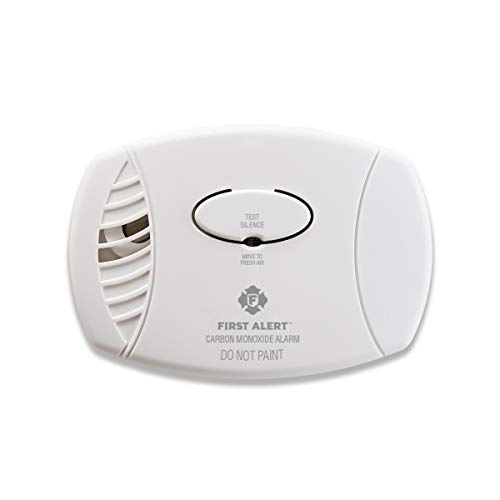
Buy the alarm with the heater, in the same order. A battery-powered CO alarm is the one that still works during a power cut, which is exactly when you are burning fuel indoors and when a mains-powered alarm is dead.
CDC's guidance is to install battery-operated or battery-backup CO detectors near every sleeping area, check the batteries when the clocks change each spring and fall, and replace the units according to the manufacturer's instructions or every five years. Add one habit for outage season: put a working alarm in whichever room you plan to heat, positioned as its own instructions specify, and test it before the first cold snap rather than during it.
And know what to do when it sounds, because an alarm nobody acts on is worth nothing. Get everyone out into fresh air immediately. Turn the heater off on the way past only if that costs you no time. Call 911 from outside, and do not go back in until the fire service tells you the air is clear. Do not silence it and wait to see what happens. Learn the difference between your alarm's alarm pattern and its low-battery chirp from the leaflet now, in daylight, rather than working it out at 2 a.m. in a cold house.
What to Avoid
The improvisations below are the ones that kill people in winter outages. The first five are on CDC's list of things never to do; the last three come from the heater's own manual and from the logic of the rest of this guide.
Never run a generator indoors or in the garage. CDC is unambiguous: "Never use a generator inside your home or garage, even if doors and windows are open." Outdoors only, and more than 20 feet from any window, door or vent. If a generator is part of your plan, the portable generator guide covers choosing one, and that 20-foot rule is the part to commit to memory.
Never burn charcoal indoors. CDC again, flatly: "Never burn charcoal indoors." It gives off carbon monoxide whatever colour the coals are, and burning it inside is a classic winter-outage fatality.
Never use a camp stove as a heater. CDC says never to use a portable gas camp stove indoors. The distinction that matters is certification: the Buddy heaters above are built and listed for indoor use with a low-oxygen shutoff, and a camping stove is not.
Do not use a portable flameless chemical heater indoors. That is CDC's wording, and it covers the catalytic heaters sold for tents and ice huts. The hand warmers in tier 1 are a different thing entirely: iron-oxidation pads that burn nothing and emit no carbon monoxide.
Never heat the house with the gas oven. It is on CDC's never list, it vents combustion gases straight into your kitchen, and it is the improvisation people reach for at 2 a.m.
Do not seal the room to keep the heat in. It is the exact instinct the 9-square-inch ventilation requirement exists to override. Taping up drafts in a room where you are burning propane removes the thing keeping the air breathable.
Do not bring the barbecue bottle inside. Covered above, and worth repeating because it is the most tempting shortcut in this guide: the manual's DANGER is "NEVER bring a refillable propane cylinder indoors."
Do not buy a kerosene heater as your first move. They heat well and plenty of people use them safely, but they add fuel storage, odour, wick maintenance and their own ventilation rules. For a household buying one thing for outage heat, propane radiant is the simpler and more forgiving choice.
How Much Propane to Keep
Work in 1 lb cylinders, because that is the indoor setup. The manual's range is 3 to 6 hours each depending on the setting, and raw energy content says nearer two and a half on high, so budget three cylinders for an eight-hour waking day in mild cold and four in a hard freeze. On that basis a dozen covers about three days comfortably rather than four at a stretch. Treat the hard-freeze rate as the one to plan on whenever the forecast is near or below 20°F, and buy more than you think you need. They store well for years, though not forever: the manual says not to use a cylinder whose head is damaged, punctured or deteriorated, so look each one over before you screw it on. Buy them locally, too, since 1 lb propane is usually restricted from parcel delivery.
That hard-freeze figure exists because the manual warns runtimes drop significantly on continuous use below about 20°F, and that is exactly when it recommends the 20 lb tank setup instead. If you go that way, the bottle stays outdoors with the correct Mr. Heater hose and fuel filter, never inside, and the manual frames that arrangement for enclosures like cabins and porches rather than for a house.
Store them where the manual says, which is not indoors at all: "Cylinders must be stored outdoors, in a well-ventilated space, out of the reach of children, and must not be stored in a building, garage, or any other enclosed area." It also says a cylinder that is not connected for use should not sit near the heater or any other appliance. Keep them upright, out of direct sun, and rotate the stock by using the odd one on a camping stove in summer rather than letting a decade pass.
Related Guides
What to do in a power outage is the hour-by-hour playbook for the outage itself.
Best solar generator for home backup goes deeper on the battery tier, including what each capacity class genuinely runs.
Best winter car emergency kit is the same logic applied to being away from the house when the storm hits.
Buy It Before the Forecast
Here is the verdict one more time: a Mr. Heater Portable Buddy, a First Alert CO400 alarm, and a dozen 1 lb propane cylinders. That is a weekend errand, and it is the difference between a storm that empties your house and a storm you sit out in a warm room with the lanterns on. Set it up once, open the window top and bottom when you run it, keep the children clear of the grill, never sleep with it burning, and the next multi-day outage becomes a story about board games rather than a story about pipes.
Frequently Asked Questions
Is it safe to use a propane heater indoors during a power outage?
Only a heater built and listed for indoor use, only on the fuel setup its manual clears for indoor use, and only by that manual. For the Mr. Heater Portable Buddy that means a disposable 1 lb cylinder, never a refillable barbecue bottle, which the manual bans from indoors outright. It needs a minimum vent area of 9 square inches at both ceiling and floor level, with both openings to outside air, because it is an unvented heater that burns the oxygen in the room. It must never run while you sleep or unattended, and a battery-powered carbon monoxide alarm belongs in the same room. Indoor use is not approved in Canada or Massachusetts, and the manual also says it is not for use in a dwelling home in California.
Can I connect a 20 lb propane tank to a heater indoors?
No. The Portable Buddy manual carries it as a DANGER: never bring a refillable propane cylinder indoors, because a fire or explosion can cause serious injury or death. The long-runtime setup is allowed only with the cylinder outdoors, connected through one of Mr. Heater's specified hoses and a fuel filter, and the manual frames that arrangement for enclosures such as cabins and porches. Indoors, use 1 lb disposable cylinders.
Can a portable power station run a space heater?
Not for any useful length of time. A plug-in space heater draws about 1,500 watts on high, so a 1,056Wh battery such as the Anker SOLIX C1000 runs it for roughly 42 minutes, less once inverter losses are counted, or about an hour and a half on the heater's 750-watt low setting. Batteries are for lights, phones, routers and the fridge. Heat needs fuel.
How much propane do I need for a winter outage?
Think in 1 lb cylinders, since that is the indoor setup. The manual's range is 3 to 6 hours per cylinder depending on the setting, and raw energy content says nearer two and a half on high, so budget three cylinders for an eight-hour waking day in mild cold and four in a hard freeze. A dozen then covers about three days comfortably rather than four at a stretch. Below about 20°F expect less again, because the manual warns runtimes drop significantly at those temperatures, and it recommends the outdoor 20 lb tank setup in that weather.
Where should I put a carbon monoxide alarm during an outage?
CDC guidance is to have battery-operated or battery-backup CO alarms near every sleeping area, check the batteries when the clocks change, and replace the units per the manufacturer or every five years. For an outage, add one in whichever room you are heating, positioned as its own instructions specify, and test it before the cold arrives rather than during it.
What should I do if the carbon monoxide alarm goes off?
Get everyone out into fresh air immediately, turning the heater off on the way past only if it costs you no time. Call 911 from outside and do not go back in until the fire service says the air is clear. Do not silence the alarm and wait to see what happens, and learn the difference between your alarm's alarm pattern and its low-battery chirp from the leaflet before the season starts.
What are the early signs of carbon monoxide poisoning?
They look like flu. The Portable Buddy manual warns of headache, dizziness and nausea, and says to get fresh air at once if you have them. CDC lists headache, dizziness, weakness, upset stomach, vomiting, chest pain and confusion, and calls them flu-like. In a cold, dim house it is tempting to blame the stress of the outage, so treat those symptoms as carbon monoxide until proven otherwise and get everyone outside.
Does the low-oxygen shutoff protect me from carbon monoxide?
No, and this is the most important thing to understand about these heaters. The sensor measures oxygen, not carbon monoxide, and the manual describes it as shutting the heater off when not enough fresh air is available. Poor ventilation or a dusty burner can put carbon monoxide into a room while oxygen stays above the trip point. That is why the ventilation openings and the battery CO alarm are both mandatory rather than optional.
Can I run a generator in the garage with the door open?
No. CDC says never to use a generator inside a home or garage even with doors and windows open, and to keep it outdoors more than 20 feet from any window, door or vent. The same goes for burning charcoal indoors, using a camp stove or a flameless chemical heater as indoor heat, or heating the house with a gas oven.
Is a kerosene heater better than propane for outage heat?
Not as a first purchase. Kerosene heats well and plenty of people use it safely, but it adds fuel storage, odour, wick maintenance and its own ventilation rules. For a household buying one thing for emergency heat, an indoor-rated radiant propane heater is simpler and more forgiving.