
Best Whole-Home Battery Backup Under $5,000 (2026)
The best whole home battery backup is the EcoFlow DELTA Pro Ultra: 7,200W runs a whole house, no installer, no five-figure install. 5 DIY systems compared.

Practical home resilience for normal families. No bunkers, no ideology. Just sensible preparation that saves money and stress when things go sideways.
Just so you know, some links on this page are affiliate links. If you buy something via them, we get a small kickback. You don't pay more, but it helps keep this independent.
Not sure what to buy? Take the quiz.
Find My SetupFor years, keeping a whole house running through an outage came down to two poor options: a petrol generator roaring on the drive at 3am, or a hardwired battery like a Tesla Powerwall with a five-figure installation bill to match. There is now a third way, and it is the one I would reach for. A new class of expandable battery runs an entire house, air conditioning and well pump included, for less than five thousand dollars, and you wheel it in and set it up yourself. The one I would put in most homes is the EcoFlow DELTA Pro Ultra: 7,200 watts of split-phase output, LiFePO4 cells rated well past a decade of daily cycling, and capacity you can stack as high as you actually need. No electrician on a waitlist, no permit, no fuel to store.
Quick Picks
A quick word on how I got to these picks. I have not wired every one of these into a breaker panel myself. What follows comes from the manufacturers' published specifications, the long threads on r/SolarDIY, r/preppers, and the off-grid forums where owners report what actually happened when the grid went down, and the pattern across independent testing of how these units hold up under real load. Whole-home backup is a purchase where the boring numbers decide everything: output in watts, capacity in kilowatt-hours, and whether a unit does split-phase 240V or not. That is what I have leaned on, because it is what you will live with.
The tier that did not exist three years ago
Here is the gap that just closed. A portable power station, the kind you buy for a thousand dollars and I cover in the best solar generator guide, keeps a fridge, a router, and some lights alive through an outage. That is genuinely useful, and for a lot of families it is the right first purchase. But it will not run a well pump, it will not run central air, and it will not carry a whole house for two days.
At the other end sits the installed home battery: a Tesla Powerwall or an Enphase system wired into your electrical panel by a certified installer. That runs the whole house, and it is excellent, but it is building work. You wait weeks for quotes, you pay for the hardware and then again for the labour and the permit, and the whole thing lands in five figures once it is done. I walk through that world in the installed home battery guide, and for the right home it is money well spent.
What changed in the last couple of years is the middle. Manufacturers took the portable power station, gave it split-phase 240V output, real 6,000-to-7,200-watt inverters, and stackable batteries, and priced the whole class under five thousand dollars. These are not permanent fixtures. They roll in on wheels or sit in a utility room, they plug into your house through a transfer switch or a smart panel, and you set them up in an afternoon. For the enormous number of homes that want serious backup but cannot justify a Powerwall install, this tier is the answer, and it is where I would spend the money today.
What "whole-home" actually requires
Three numbers separate a real whole-home battery from a big portable, and getting them right is the whole game.
Start with continuous output, measured in watts. This is how much the unit can run at once, not how long. A house does not sip power evenly: the well pump kicks in, the air conditioner compressor starts, the microwave and the kettle overlap. To cover those without tripping, you want serious headroom. Anything claiming whole-home backup should start around 6,000 watts, and if you run central air or a deep well, 7,200 watts is the number that stops you playing musical chairs with your appliances.
The second is split-phase 240V. This is the one buyers miss, and it is the one that matters most. Ordinary portable stations put out 120V only. A well pump, an electric range, a central air conditioner, an electric dryer, and most whole-house systems run on 240V. If a unit cannot produce split-phase 240V, it physically cannot power those loads, no matter how big the battery is. Every system I recommend here does true 240V. That single capability is the line between a big portable and a whole-home battery.
The third is capacity, measured in kilowatt-hours, which is how long it lasts. This is where expandability earns its keep. A base unit of four or five kilowatt-hours will carry a careful house overnight. Add expansion batteries and you stretch to days. The smart move is to buy the inverter and one or two batteries now, then add capacity later without replacing anything. That is why the stackable systems win: your first outage tells you exactly how much battery you actually need, and you buy the rest then.
One honest note before the picks. Most homes do not need to run everything at once, and pretending otherwise is how people overspend. The realistic plan is to back up the circuits that matter, the fridge and freezer, the heating controls, the well pump, the internet, a few outlets, and let the pool heater and the electric oven sit dark for a day. Size for what you genuinely need running, not for a fantasy of business as usual.
The systems at a glance
Five systems, all doing split-phase 240V, all buyable on Amazon, all under the five-thousand-dollar line before expansion. Here is how they stack up before the detail.
| System | Base capacity | Continuous output | 240V | Best for |
|---|---|---|---|---|
| EcoFlow DELTA Pro Ultra | 6,144Wh | 7,200W | Yes | Whole home including central AC |
| Anker SOLIX F3800 Plus | 3,840Wh | 6,000W | Yes | 240V workhorse you expand over time |
| Jackery Solar Generator 5000 Plus | 5,040Wh | 7,200W | Yes | Biggest single box, simplest setup |
| Bluetti Apex 300 | 2,764Wh | 3,840W | Yes | Cheapest way into the tier |
| EcoFlow DELTA Pro 3 | 4,096Wh | 4,000W | Yes | Affordable step down that still does 240V |
The best whole-home battery overall: EcoFlow DELTA Pro Ultra

If you want the system I would actually put in, this is it. The DELTA Pro Ultra is built to be the heart of a house, not a camping accessory that got promoted. A single unit pairs a 6,144Wh LiFePO4 battery with a 7,200-watt inverter that does full split-phase 120/240V, and that output figure is the one that matters: 7,200 watts is enough to start and run a three-ton central air conditioner, which almost nothing else in this price class can honestly claim.
The reason it earns the top spot is what happens when one unit is not enough. Through EcoFlow's Smart Home Panel 2, you stack up to fifteen batteries across three inverters and climb to 90kWh, which is genuinely off-grid territory. Most people will never go that far, and that is the point: you buy one inverter and one battery now, wire it to the panel, and add capacity the year you decide you want three days instead of one. The LiFePO4 cells are rated past 3,500 full cycles to eighty percent, so this is a ten-year-plus fixture, and it recharges a full battery in about two hours from the wall.
The honest catch is that the Ultra is the premium option here, and paired with the Smart Home Panel it is the closest thing in this guide to an installed system, which means the cleanest installs involve an electrician wiring the panel in. It is also heavy and wants a permanent home in a garage or utility room rather than a unit you shuffle around. But if your goal is to power a whole house, air conditioning included, and never think about it again, nothing else here does the job as completely.
The 240V workhorse: Anker SOLIX F3800 Plus

If the Ultra is more system than you want to commit to, the F3800 Plus is the one I would point most people to instead. It delivers 6,000 watts of continuous output with true split-phase 240V from a single unit, which means it runs a well pump or an electric range straight out of the box, and it does it on wheels with a proper handle so one person can move it. The base battery is 3,840Wh, and you expand it with add-on batteries as your needs grow, stacking well into whole-home capacity.
What I like about the Anker approach is how sanely it scales. You can run it as a big portable on day one, powering circuits through an inlet or a transfer switch, and later bolt on Anker's Home Power Panel for automatic whole-house switchover. It is the same LiFePO4 longevity story as the rest of this list, and the 3,200-watt solar input means that if you ever add panels, it refills fast. The suitcase-with-wheels design is genuinely thoughtful for something this powerful.
The trade-off against the EcoFlow Ultra is ceiling and integration. The F3800 Plus tops out at less total capacity than the Ultra's 90kWh, and its whole-home panel ecosystem is a step less seamless than EcoFlow's. For the overwhelming majority of homes that want strong 240V backup without going all the way to a permanent install, that ceiling is far higher than you will ever reach, and the value is excellent.
The value way in: Bluetti Apex 300

Not everyone needs to solve the whole house on day one, and the Apex 300 is the smart way to start. It is the successor to Bluetti's popular AC500, and on its own it delivers 3,840 watts with split-phase 240V from a 2,764Wh battery. That alone will not run a whole house for long, and I want to be straight about that. What makes it the value pick is the path: add B300K expansion batteries and you climb toward 19kWh from a single unit, or parallel two units for more output, so you build to whole-home capacity one purchase at a time.
This is the modular play, and it suits a particular buyer well: someone who wants real 240V capability and a serious inverter now, but wants to spread the battery cost over a year or two rather than pay for capacity they are only guessing at. Start with the base unit covering your essential circuits, live through an outage or two, then add the battery you now know you need. It is LiFePO4 like the rest, and it charges fast from AC.
The honest limitation is that the base unit is the smallest battery in this guide, so bought alone it is a big portable with whole-home ambitions rather than a finished whole-home system. Buy it understanding that the expansion is part of the plan, not an optional extra, and it is the most affordable sensible route into the tier.
The biggest single box: Jackery Solar Generator 5000 Plus
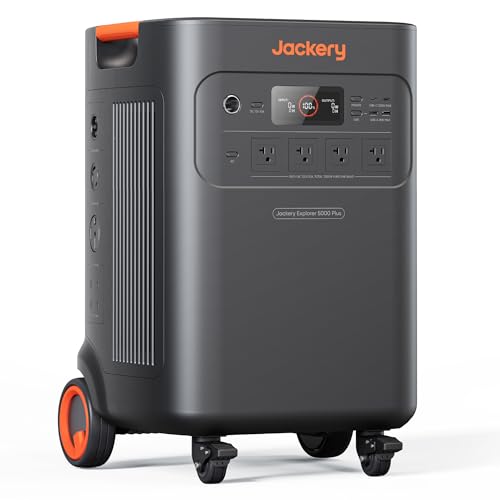
If the idea of stacking panels and expansion modules makes your eyes glaze over, the Jackery 5000 Plus is the simplest big-capacity answer. One unit gives you 5,040Wh of LiFePO4 storage and 7,200 watts of split-phase 240V output, which is a lot of house in a single wheeled box. It expands to 60kWh if you want it to, but its appeal is that it does not need to: out of the crate it has more usable capacity than most of the base units here and enough output to run heavy 240V loads.
This is the pick for the person who wants to buy one thing, wheel it in, connect it through a transfer switch, and be done. Jackery's kit is famously straightforward, the app is simple, and the version bundled with a smart transfer switch takes most of the guesswork out of connecting it to essential circuits. Recharge is quick, and the whole experience is aimed at people who want backup power, not a hobby.
The trade-off is that you pay for that single-box capacity, and the ultimate expansion ceiling and ecosystem are narrower than EcoFlow's. But if simplicity and a large ready-to-go battery matter more to you than squeezing out the last kilowatt-hour of scalability, this is the easy button, and it is a good one.
The affordable step down that still does 240V: EcoFlow DELTA Pro 3

Not every home needs 7,200 watts. The DELTA Pro 3 is the unit I would look at if you want split-phase 240V and real backup capacity without reaching for the top of the range. It gives you 4,096Wh and a 4,000-watt inverter with split-phase 240V, which covers a well pump and the essential circuits of most homes comfortably, and it slots into the same EcoFlow ecosystem, so you can pair it with a smart panel and expand later.
Think of it as the sensible middle: more than a portable, less than the Ultra, and priced to match. For a home whose big 240V load is a well pump rather than central air, four thousand watts is plenty, and the money you save over the Ultra buys a lot of expansion battery. It is the same LiFePO4 durability and fast recharge that runs through EcoFlow's line.
The limitation is simply headroom. If you have central air conditioning you want to run, the 4,000-watt output will make you choose your loads carefully, and the Ultra's 7,200 watts is worth the step up. But for the many homes without a heavy 240V cooling load, the DELTA Pro 3 is the value-conscious way to get genuine whole-home backup.
How you actually connect it to the house
This is the part that scares people off, and it should not. There are three ways to get power from one of these units into your home, and they run from dead simple to a single electrician visit.
Simplest of all is extension cords. You run heavy-gauge cords from the unit to the appliances you care about, the fridge, a space heater, the router. It is ugly, it does not touch your 240V circuits, and it is completely safe because nothing is wired into your house. For a first outage while you decide what you really want, it is a fine start, and it pairs with the rest of a sensible power-outage plan.
The proper answer for most people is a manual transfer switch. This is a small box an electrician fits next to your main panel, wired to the specific circuits you want to back up, the well pump, the furnace blower, the kitchen, a few rooms. When the power fails, you plug the battery into an inlet, flip the switch, and those circuits run off the battery. It is the standard, code-compliant way to power hardwired 240V loads, it costs an afternoon of an electrician's time, and it is the step that turns a big battery into real whole-home backup. Some of these systems, the Jackery 5000 Plus among them, sell a matched transfer switch to make this straightforward.
The premium route is a smart panel, like EcoFlow's Smart Home Panel 2 or Anker's Home Power Panel. This replaces or supplements your load centre and switches to battery automatically the instant the grid drops, with no flipping anything, plus app control and consumption monitoring. It is the most seamless experience and the most like an installed Powerwall, and it is the one job in this guide where I would always use a licensed electrician.
Whichever route you choose, one rule is absolute: never backfeed power into your house through a dryer outlet or a homemade cord. It can kill a lineman working on the grid and it can burn your house down. Use an inlet and a transfer switch. That is the whole reason the switch exists.
What to Avoid
The single most expensive mistake in this category is buying on battery size alone and ignoring output. A 5kWh unit that only manages 3,000 watts and 120V will leave you unable to start your well pump or your air conditioner while a smaller battery with a 6,000-watt split-phase inverter runs them fine. Read the output number and the 240V capability first, and treat capacity as the second question, not the first.
Avoid any unit sold for whole-home backup that does not do split-phase 240V. Plenty of large 120V-only power stations are marketed with photos of houses, and they are excellent for a fridge and a freezer, but they physically cannot run a 240V well pump, range, or central air. If those loads matter to you, a 120V-only unit is the wrong tool no matter how big the battery.
Be wary of buying more capacity than you can recharge. A giant battery is only useful if you can refill it. If you have no solar and outages in your area run for days, think hard about how the unit charges once it is empty, whether from the grid before the storm, from a small generator, or from panels you have actually bought. Capacity you cannot replenish is a one-time fund, not a system.
Finally, avoid older NMC-chemistry power stations sold cheap to clear stock. Every system in this guide uses LiFePO4 for a reason: it is safer, it tolerates being kept full, and it lasts three times as many cycles. A whole-home battery is a long-term fixture, and the chemistry is the one thing you cannot upgrade later.
What to look for
A few things decide whether you buy the right system.
Continuous output first. Six thousand watts is the sensible floor for whole-home backup, and 7,200 watts is what you want if you run central air or a deep well pump. This is the number that determines what you can run at the same time.
Split-phase 240V, non-negotiable if you have any 240V loads. Well pumps, electric ranges, central air, and electric dryers all need it. Confirm the unit does true split-phase, not just a 240V-looking outlet.
Capacity and, more importantly, expandability. Buy the inverter and a battery or two now, and choose a system that lets you add capacity later without replacing the unit. Your first real outage will tell you how much battery you actually need.
Chemistry. LiFePO4 only for something you intend to keep for a decade. It is safer, longer-lived, and happy sitting at full charge waiting for the day you need it.
Connection ecosystem. Look at how the unit ties into your house, whether it is a simple transfer switch or the manufacturer's smart panel, and factor a single electrician visit into your plan for the 240V connection. It is the difference between a battery in the garage and backup that just works.
What I'd buy today
For most homes that want to run the whole house through an outage, I would buy the EcoFlow DELTA Pro Ultra. Seven thousand two hundred watts of split-phase output that starts a central air conditioner, LiFePO4 cells that will still be working in a decade, and a battery you can stack as high as you like is exactly what I would want standing between my family and the next long outage.
If you want that same 240V muscle in something you can wheel around and grow into over time, get the Anker SOLIX F3800 Plus. And if you would rather start small and build, the Bluetti Apex 300 gets you into the tier for the least money and expands when you are ready. Whichever you pick, the day you set it up is the day a power cut stops being an emergency and becomes a minor inconvenience, which is the entire point.
As an Amazon Associate, we earn from qualifying purchases.
Products Mentioned in This Guide
EcoFlow DELTA Pro Ultra Whole-Home Battery Backup
EcoFlow
6,144Wh LiFePO4 battery paired with a 7,200W inverter (10,800W surge) that delivers full split-phase...
Anker SOLIX F3800 Plus Portable Power Station
Anker
3,840Wh LiFePO4 base battery with a 6,000W inverter (9,000W peak) that delivers true split-phase 120...
Bluetti Apex 300 Portable Power Station
Bluetti
Successor to the AC500. A single unit delivers 3,840W (7,680W surge) with split-phase 120/240V from ...
Jackery Solar Generator 5000 Plus Portable Power Station
Jackery
The simplest big-capacity option. A single wheeled unit gives 5,040Wh of LiFePO4 storage and 7,200W ...
EcoFlow DELTA Pro 3 Portable Power Station
EcoFlow
4,096Wh LiFePO4 battery with a 4,000W inverter and split-phase 120/240V from a single unit, enough f...
Not sure what to buy?
Tell me about your home and I'll tell you which resilience gap to close first.
Find My SetupFrequently Asked Questions
Can a portable power station really run a whole house?
Yes, but only the ones built for it. A whole-home unit needs split-phase 120/240V output and serious wattage, around 6,000W at a minimum and 7,200W if you run central air or a deep well pump. Ordinary 120V-only stations, however large the battery, cannot run 240V loads. Most people back up their essential circuits rather than everything at once.
Do I need an electrician to install a whole-home battery?
For a manual transfer switch or an automatic smart panel, yes, and it is usually a single afternoon visit. You can run individual appliances off heavy-gauge extension cords with no wiring at all, which is a fine way to start. Never backfeed power into your house through a dryer outlet or a homemade cord: it is dangerous and against code.
What size battery do I need to back up my home?
It depends on which circuits you want running and for how long. A base unit of four to five kilowatt-hours will carry a careful house overnight; add expansion batteries and you stretch to days. The smart approach is to buy the inverter and one or two batteries now, then add capacity after your first real outage tells you what you actually use.
Is a portable whole-home battery cheaper than a Tesla Powerwall?
Substantially. An installed Powerwall or Enphase system runs into five figures once you add the electrician and the permit, while these expandable systems sit under five thousand dollars before expansion and you set them up yourself. The trade-off is that you handle the transfer switch or smart panel connection rather than getting a turnkey install.
Can a battery backup run central air conditioning?
Only the largest units can. Starting and running a three-ton central air conditioner needs around 7,200W of split-phase output, which the EcoFlow DELTA Pro Ultra and Jackery 5000 Plus deliver. Smaller 4,000W systems will run a window unit or a mini-split comfortably, but not whole-house central air. Check the surge and continuous wattage against your compressor before you buy.
Related Guides
Best Solar Generator for Home Backup 2026: EcoFlow, Jackery, and Bluetti Compared
powerHome Backup Power Explained: Solar Generator, Gas Generator, or Battery Pack?
powerBest Home Battery Backup System 2026: Whole-House Options Jeff Actually Considered
powerWhat to Do in a Power Outage: Jeff's Family Protocol
Not sure which guide to read first?
Take the quiz — Jeff will tell you which gap to close first based on your home and budget.
Take the Quiz — It's FreeNo email required