UK Off-Grid Living: What's Realistic for Suburban Families (Not What YouTube Shows)
Full off grid living uk suits a lifestyle goal, not just a resilience strategy. Most suburban families do better choosing the partial route. Jeff's breakdown.

Practical home resilience for normal families. No bunkers, no ideology. Just sensible preparation that saves money and stress when things go sideways.
Just so you know, some links on this page are affiliate links. If you buy something via them, we get a small kickback. You don't pay more, but it helps keep this independent.
Not sure what to buy? Take the quiz.
Find My SetupThis is not a guide about going off-grid, and it is worth being upfront about that from the start.
Picture an ordinary household: two school-age children, two working adults, a mortgage, three miles from the nearest town. Now compare a genuine off-grid setup — a retired couple eight years in, with a 15kW solar array, two 60kWh battery banks, a borehole, their own sewage treatment plant, and no mortgage. That is a completely different life, and a useful reminder that building resilience for a normal family is a different goal from off-grid living.
The productive path is a year spent reading about off-grid living seriously, visiting people who do it, understanding what it actually costs at each level, and implementing the parts that make sense for an ordinary household. Which turns out to be a lot of them. Just not going fully off-grid.
This guide is for the people who are, like me, genuinely curious but realistic. Not the YouTube fantasy of a self-contained smallholding with a scenic mountain backdrop. The practical question of what a suburban UK family can actually do.
Off-Grid Is a Spectrum: The Four Levels
YouTube presents off-grid living as a binary: either you are connected to utilities or you are not. The reality is a spectrum, and the vast majority of people who are "going off-grid" are somewhere in the middle.
Level 1: Grid-Dependent Resilience
This is where most prepared families sensibly land. Connected to the grid, but with enough backup capacity to function through disruptions: a power station like the EcoFlow DELTA 2 for power cuts, a gravity water filter and stored water for supply disruptions, and a three-month food pantry so a supply-chain problem does not reach the kitchen.
This is the least glamorous description but the most honest. It is also, in my view, the right place for most suburban families to start — and a perfectly adequate destination for many.
Level 2: Partial Off-Grid
Partial off-grid means generating some of your own energy and/or water, while remaining connected to mains utilities as a backup. The most common version: rooftop solar with a home battery, reducing grid dependency by 60-80% in summer, 20-40% in winter.
This is achievable for most UK homeowners with suitable roofs. It is a 10-20 year financial commitment (solar + battery payback period) that makes sense at current electricity prices. It does not mean you never need the grid; it means you need it much less.
Level 3: Near Off-Grid
Near off-grid means covering most of your energy needs from generation, with grid connection as infrequent backup. In the UK context, this typically requires: - 10-20 solar panels (depending on household size) - 20-40 kWh of battery storage (multiple units) - A secondary generation source for winter (ground-source heat pump with thermal storage, micro-hydro if you have a suitable water source, or simply accepting grid use October-February)
The cost at this level: £40,000-80,000 for energy systems. Not including water independence, which is a separate cost.
Level 4: Fully Off-Grid
Full off-grid — no grid connection, no mains water, off-grid sewage — requires: - Energy: £60,000+ for a system that handles UK winters - Water: borehole (£8,000-20,000) or spring collection with treatment system - Sewage: septic tank or package treatment plant (£5,000-15,000 depending on site) - Land: rural with no right-to-connect issues
And it requires a different relationship with your energy use. People who successfully live fully off-grid are, in my observation, not people who want to live like they did before but without the bills. They are people who genuinely reorganised their relationship with energy and consumption.
A Worked Example (Partial Off-Grid — Level 2)
Here is what a realistic Level-2 setup looks like in concrete terms rather than in theory:
Energy: An EcoFlow DELTA 2 (1,024 Wh, charges from solar panel or grid, handles the chest freezer and essentials during power cuts). Rooftop solar is the obvious next step, though it often waits on roof repairs before installation makes sense.
Water: A British Berkefeld gravity filter for drinking water. Two 55-gallon barrels in the garage for emergency storage. Two water butts collecting rainwater from the garage roof for garden use. The mains water connection stays essential — not something to replace in the near term.
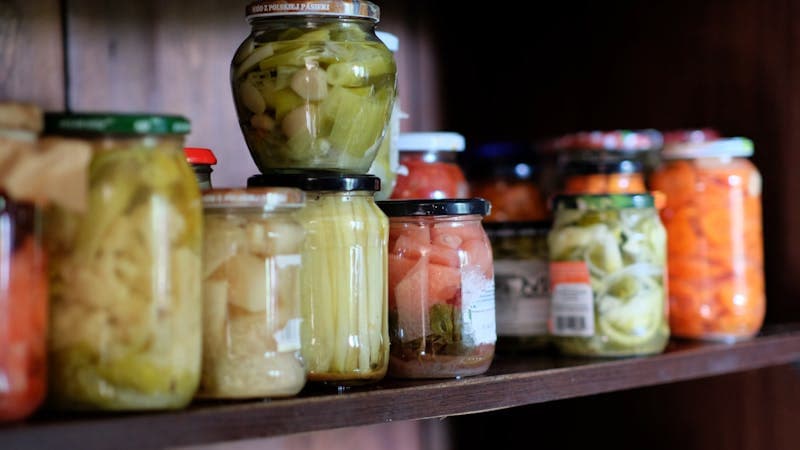
Food: A chest freezer of homegrown frozen produce, supplemented by a three-month pantry of dry goods. A realistic home garden might supply around 40% of the vegetables a household eats from May through October, and very little worth eating from November through March. You buy the rest.
Heating: Gas central heating, with a log-burner in the sitting room that can take over one room entirely during a gas supply failure. Not a heat pump, not biomass — gas, with one manual backup.
Total invested: approximately £4,000 over three years (EcoFlow, filter, barrels, water butts, extra chest freezer). Monthly running cost: essentially nothing beyond normal utility bills.
Solar and Battery for a UK Home: The Realistic Numbers
People often come away from solar installation quotes surprised that the numbers are less dramatic than the YouTube claims suggest. Here is an honest version.
A typical UK semi-detached home uses 3,500-4,000 kWh of electricity per year. Solar panels on a south-facing roof at 35-45 degree pitch in southern England might generate 3,000-3,500 kWh per year from a 4kW system (12-14 panels). In the Midlands and north, expect 15-20% less.
The catch: solar generates most of its power in summer, between 10am and 3pm. If you are at work from 9 to 5, you export most of that generation to the grid (getting paid very little for it via the Smart Export Guarantee) and import grid electricity in the evenings. Without a battery, self-consumption of solar generation is typically 30-40% of total generation.
With a battery (10 kWh): self-consumption rises to 70-80% in summer, with minimal improvement in winter (not enough winter generation to fill a 10kWh battery daily). Battery payback period adds 8-12 years to the system cost at current electricity prices.
Overall, the numbers are reasonable for people who place value on energy independence beyond pure financial return — which I do, which is why we are planning to install. They are not the "pay nothing for electricity" scenario that some social media content implies.
Water Independence in the UK: What's Legal and What Works
Rainwater harvesting in the UK is legal and widespread. You do not need planning permission for domestic rainwater collection (with minor exceptions in certain conservation areas). The key distinction is between above-ground water butts (no restrictions) and below-ground cisterns (may require building regulations approval depending on size).
What rainwater works for without treatment: garden irrigation, toilet flushing, car washing, outdoor cleaning. What it requires treatment for: any potable use.
A typical UK roof receives approximately 600-900mm of rainfall per year. A 100 square metre roof section in the UK captures around 70,000-90,000 litres annually — more than enough for a family's non-potable use and a significant portion of potable use if treated.
Treatment for potable use from collected rainwater typically requires: first-flush diverter (discards the initial dirty runoff from a dry roof), sediment filter, activated carbon filter, UV sterilisation. This is achievable but adds £500-2,000 to the system cost and requires maintenance.
My honest assessment: for most UK suburban families, rainwater collection makes sense for garden use (where it is free, simple, and requires no treatment). For potable use, the treatment system cost and maintenance requirement means mains water remains the more practical option for most people.
Borehole water (drilling for groundwater): legal, and common in rural areas without mains water. Cost: £8,000-20,000 depending on depth and ground conditions. Requires Environment Agency licence if abstracting more than 20 cubic metres per day. The geology needs to be right — not every location has accessible groundwater.
Food Independence: What It Actually Takes
Growing your own food is wonderful. We say this as someone who does it. But the honest number is uncomfortable: a British family of four eating a typical UK diet needs roughly 1.7 acres of productive land to be self-sufficient in calories. That is a smallholding, not a garden.
What a suburban garden can realistically provide: vegetables and fruit in season (May-October for most produce in the UK). A productive 100 square metre kitchen garden can supply most of a family's vegetable needs in season. It cannot supply protein, fats, grains, or winter vegetables without a much larger operation.
The practical conclusion: grow what grows well, preserve the surplus, and buy what you cannot grow. This is not failure — it is appropriate use of resources. Courgettes, tomatoes, salad, beans, and soft fruit reward the effort; buy everything else.
The Honest Cost Breakdown at Each Level
| Level | Setup Cost | Annual Running | What You Get |
|---|---|---|---|
| Level 1 (Grid-Resilient) | £2,000-6,000 | Negligible | 72-hour+ power/water/food resilience |
| Level 2 (Partial Off-Grid, solar+battery) | £15,000-25,000 | Reduced grid bills | 60-80% energy self-sufficiency (summer) |
| Level 3 (Near Off-Grid) | £40,000-80,000 | Some grid import | Year-round energy self-sufficiency |
| Level 4 (Fully Off-Grid) | £80,000-150,000+ | Maintenance only | Full independence |
These numbers do not include the opportunity cost of land, structural changes to property, or the learning time required to operate complex systems. Full off-grid living is a lifestyle change, not just a set of purchases.
If we Were Starting Again: What She Would Prioritise
In order:
1. **Gravity water filter** — one week and £150. Covers drinking water for any supply disruption.
2. **Three-month food pantry** — one month to assemble. Covers food supply disruption and actually reduces grocery spending.
3. **Portable power station (EcoFlow DELTA 2 or equivalent)** — covers the most immediate power resilience need.
4. Chest freezer — extends food preservation capacity dramatically, connects to the EcoFlow during power cuts.
5. Rainwater collection — one day to install water butts. Free garden water indefinitely.
6. Rooftop solar + battery — when the finances allow and the roof is ready. The biggest investment but the one with the clearest long-term return.
Frequently Asked Questions
Is off-grid living legal in the UK?
Generating your own electricity is legal. Storing rainwater for non-potable use is legal. Boreholes require Environment Agency registration above certain abstraction volumes. Off-grid sewage treatment requires a suitable system and may require planning permission. There are no laws preventing UK residents from living off-grid in general — the practical and financial constraints are more significant than the legal ones.
How much does off-grid solar cost for a UK home?
A 4kW solar system with 10kWh battery: typically £12,000-18,000 installed through an MCS-certified installer. Prices have fallen 40-50% over the last decade and continue to decrease slowly. The VAT on residential solar installations is currently 0% in the UK.
How does off-grid living work in winter in the UK?
Winter is the hard problem. Solar generation drops by 70-80% from summer peaks. Most off-grid UK properties use a backup generator, wood-burning heating, or ground-source heat pump with thermal storage to bridge the winter deficit. The seasonal nature of UK solar is the single biggest practical challenge for full off-grid living.
Related Guides
The foundation of home resilience: Home Resilience Guide: our 4-Pillar Framework Immediate backup power: Best Solar Generator for Home Backup Whole-home battery systems: Best Home Battery Backup System 2026 Growing your own food: How to Start a Vegetable Garden for Food Security
The honest version of off-grid living for a UK suburban family is not the dramatic solar-powered farmhouse on the hill. It is a series of practical investments in resilience, made one at a time, that reduce your dependency on systems you cannot control. That is achievable. And it turns out it is also satisfying in a way that is hard to explain until you have done some of it.
Not sure what to buy?
Tell me about your home and I'll tell you which resilience gap to close first.
Find My SetupRelated Guides
Not sure which guide to read first?
Take the quiz — Jeff will tell you which gap to close first based on your home and budget.
Take the Quiz — It's FreeNo email required